
10 ecommerce CRO tips that lift Shopify sales 11-15%
Field-tested CRO tips that compound to 11-15% conversion uplift in 90 days across 20,000+ Shopify stores: UX, reviews, UGC, quiz-led email capture, Shop Pay and page speed.
Ten field-tested conversion rate optimisation techniques to lift your store’s conversion rate without spending another dollar on traffic acquisition. Each tip is paired with the data and the tooling that actually moves the needle, and the only one that should be number one is the last. To estimate the revenue lift a quiz could add, use our quiz ROI calculator.
Quick answer
The highest-leverage CRO change you can make this week is page speed, not any of the tips above it. After that, the compounding wins are quiz-led email capture (zero-party data lands on Klaviyo contacts from day one), real reviews and UGC, and Shop Pay for mobile checkout (1.91x lift, Shopify-published merchant data).
Stores layering five or six of these tips compound to an 11-15% conversion uplift within 90 days in RevenueHunt internal data across 20,000+ stores. None of them are revolutionary on their own. The lift comes from doing several of them well at the same time.
For the broader funnel architecture these tips sit inside, see our step-by-step funnel build guide. For 11 real DTC funnels using these mechanics together, see our real funnel examples.
In this guide
- Simplify the UX and brand consistently
- Add real customer reviews
- Include user-generated content
- Add a sticky banner at the top
- Keep product descriptions concise
- Use automatic geolocation for language and currency
- Use a quiz to capture emails
- Implement email and SMS cart recovery
- Use autofill at checkout
- Improve page loading speed (the one that should be #1)
- Frequently asked questions
- Where these fit in the bigger funnel
1. Simplify the UX and brand consistently
Maintain consistent branding throughout your store. Apple’s website is a useful reference for design and copy clarity. A low-hanging fruit: make variant selection easy and compact, ideally one line. Every piece of cognitive load you remove from the customer’s decision path is conversion you keep.
2. Add real customer reviews
Per BrightLocal’s annual Consumer Review Survey, the overwhelming majority of consumers consult reviews before buying (the survey has reported the figure in the 88-98% range across recent years depending on category). Don’t fake them. Authentic mixed reviews convert better than uniformly five-star ones because shoppers trust them more, and negative feedback is a learning opportunity that helps you improve the product or the description.
3. Include user-generated content
Industry research from Bazaarvoice, Yotpo and Nosto consistently puts the lift from displaying user-generated content (photo/video reviews, customer galleries, on-product UGC) in the 25-30% conversion uplift range when surfaced well. It takes time to collect but the compounding trust signal is worth the investment.
A few tools worth comparing if you’re picking your reviews/UGC platform:
| Tool | Best for | Free tier |
|---|---|---|
| Judge.me | Solo to mid-market Shopify stores | Yes, unlimited reviews |
| Okendo | Mid-market to enterprise DTC, UGC-heavy stores | No, paid only |
| Yotpo | Multi-channel (reviews + SMS + loyalty bundle) | Yes, basic plan |
4. Add a sticky banner at the top
Use the banner to showcase your single strongest offer: free shipping over £X, a current sale, or your strongest social proof. Keep one message, not three competing ones. The whole point of a sticky banner is repetition; competing messages cancel each other out.
5. Keep product descriptions concise
Display 3 to 5 bullet points (no more, no less) in the main description. Move everything else into a collapsible section: how-to-use instructions, size guide, packaging details, estimated shipping times, refund policy. The bullets are what converts; the collapsible content reduces support tickets without crowding the buy decision.
6. Use automatic geolocation for language and currency
A must if you’re selling across multiple countries. Apps like ORBE Geolocation recommend the right market and language to each visitor based on geographic location, with GDPR and CCPA-compliant consent flows so nothing redirects without the user’s say-so. Visitors can switch markets or languages anytime via selectors that work with any Shopify theme.
Key features:
- Automatic setup against your existing Shopify Markets configuration.
- Connect multiple Shopify stores under one account.
- GDPR and CCPA compliance: no redirects without consent.
- SEO-friendly: each market gets its own surfaced experience.
- Customisable popup design via the Shopify theme editor.
Try ORBE Geolocation. We’ve worked with the founding team for years and recommend them based on the results we’ve seen on partner stores.
7. Use a quiz to capture emails
The most common email-capture mechanic is a popup subscription form. Quiz-led email capture consistently outperforms it because the customer is opting into a clear value exchange (the personalised recommendation) rather than a generic newsletter signup. RevenueHunt platform data across 20,000+ stores: 71% of top-converting quizzes collect email as part of the flow, and 75% of those make email required, not optional.
The compounding benefit: every captured email arrives with the quiz answers attached as zero-party data, which makes Klaviyo segmentation precise from the first email rather than after months of behavioural data collection. For the full activation chain, see how Klaviyo segmentation unlocks once zero-party data lands in profiles. For the quiz mechanics themselves, see how to build a successful product recommendation quiz. And for the placement and offer logic on the quiz itself, see discounts in product quizzes: the conversion playbook.
Install RevenueHunt: Recommender Quiz for Shopify.
8. Implement email and SMS cart recovery
Automate flows to recover abandoned carts. The key isn’t the channel; it’s personalisation and segmentation. A generic “you left items in your cart” sequence underperforms a flow that references the specific products and the customer’s stated preferences. Klaviyo handles both email and SMS with the same segmentation layer, and the quiz-derived properties from tip 7 become the filter logic for those flows.
9. Use autofill at checkout
Shop Pay saves credit card and shipping information across Shopify stores, enabling one-click checkout for returning visitors. Shopify’s published merchant data shows a 1.91x mobile conversion lift for Shop Pay-enabled checkouts versus standard guest checkout. If your store isn’t Shop Pay-enabled, you’re losing the mobile shoppers whose connection drops mid-checkout.
10. Improve page loading speed
Actually, this should be number one. Without it, nothing else matters. If a customer clicks your ad and never sees the landing page because it’s loading for eternity, they leave before you’ve even had the conversation. Over half of online purchases now come from mobile devices, and mobile network conditions are unpredictable.
Run Google PageSpeed Insights on your top three landing pages this week and address every red metric, starting with Largest Contentful Paint (target under 2.5s) and Cumulative Layout Shift (target under 0.1).
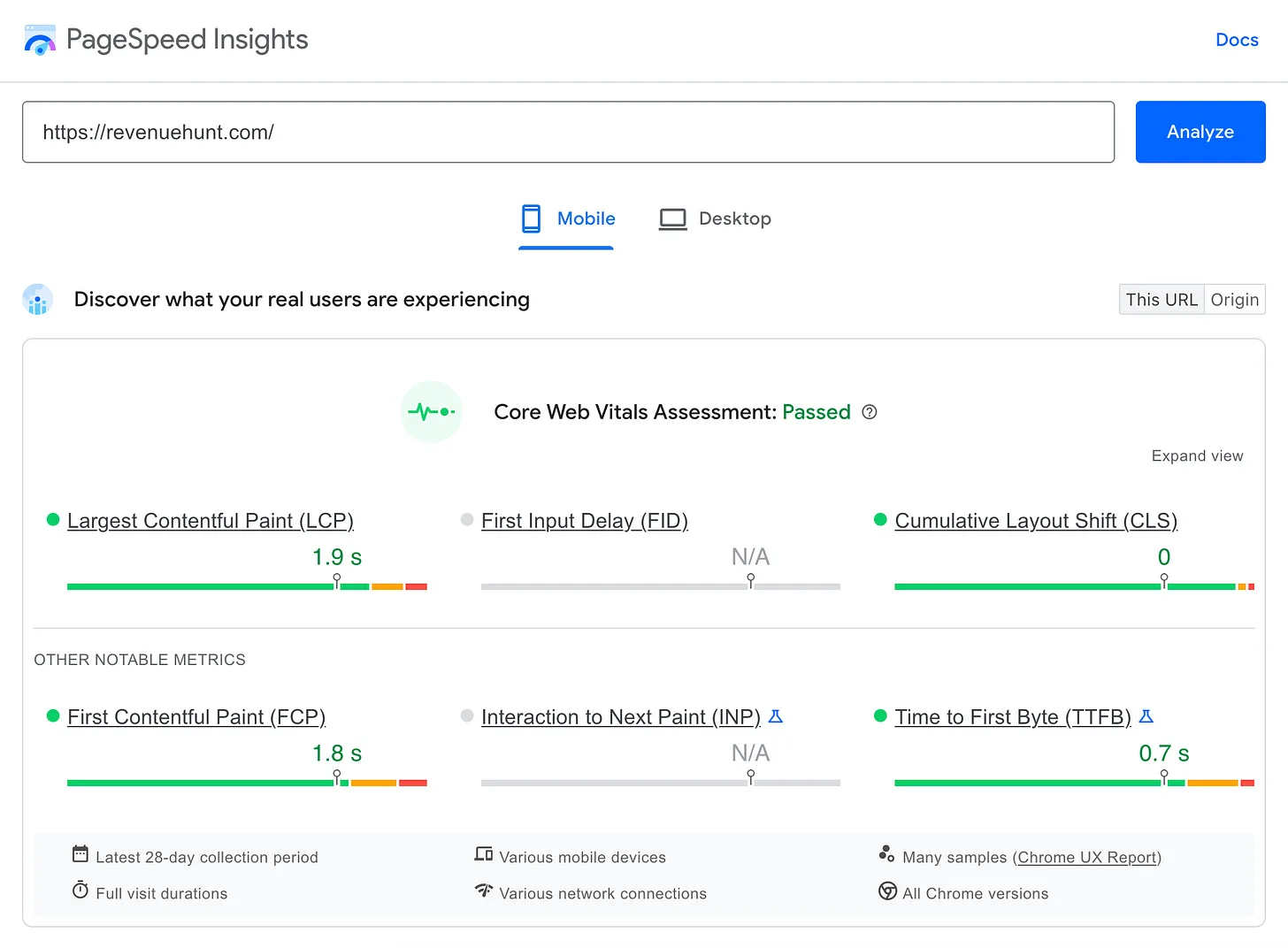
Fig. 01 PageSpeed Insights diagnostic for a real Shopify storefront. LCP and CLS are the two metrics most stores fail on first; INP (which replaced FID in March 2024) is the metric most miss in 2026.
For the deeper page-speed playbook (image lazy-loading, third-party script audit, font-loading strategy), see why more speed equals more sales.
Frequently asked questions
What is the highest-impact CRO change you can make today?
Page loading speed. Run PageSpeed Insights on your top three landing pages and fix every red metric, starting with Largest Contentful Paint (target under 2.5 seconds on mobile). Until the page loads, none of the other nine tips compound the way they’re supposed to. Tip #10 is at the bottom of this article on purpose: most operators leave it for last and shouldn’t.
Are quiz-led email captures better than popup forms?
Yes, and the gap is structural rather than tactical. A popup asks for an email in exchange for a discount. A quiz asks for an email in exchange for a personalised recommendation, with the customer’s answers attached as zero-party data on the contact record. Klaviyo segmentation becomes precise from the first email rather than after months of behavioural data collection. RevenueHunt platform data: 71% of top-converting quizzes collect email as part of the flow, and 75% of those make email required, not optional.
What’s a realistic ecommerce conversion rate lift in 90 days?
Stores layering five or six of these tips at the same time consistently land in an 11-15% conversion uplift band within 90 days, based on RevenueHunt internal data across 20,000+ stores. One tip on its own rarely moves the needle by more than a point or two. The lift comes from doing several of them well in parallel, not picking the single highest-ROI one and ignoring the others.
Do I need a separate tool for each of these tips?
Mostly no. A typical mid-market Shopify CRO stack covers most of this list with three or four tools: RevenueHunt for the quiz, email capture and zero-party data, Klaviyo for email and SMS flows, a reviews/UGC app (Judge.me, Okendo or Yotpo from the table in tip #3), and Shop Pay enabled at checkout. Page speed work is mostly theme cleanup, not a separate tool purchase.
Where these fit in the bigger funnel
Conversion optimisation isn’t a checklist you finish; it’s a discipline you compound. Each of the ten tips above improves one slice of the funnel: the awareness banner, the product page, the email capture, the cart recovery, the checkout, and the speed underneath all of it. None of them are revolutionary on their own. The lift comes from doing several of them well at the same time.
For the strategic frame that ties these tactics together, see our step-by-step ecommerce sales funnel build guide. For the data category that powers the email and quiz mechanics in tip 7, see our zero-party data guide.
Free tools & data
Put these benchmarks to work on your own store.
Free tool
Quiz ROI calculator
Estimate the extra revenue and ROI a product recommendation quiz could add to your store. Built on real data, no email required.
Calculate your ROIFree report
Ecommerce quiz benchmark report
How product recommendation quizzes really perform: conversion by category, AOV uplift, and completion, from 45M+ real quiz responses.
Read the report
Most shoppers leave because they can't find the right product