
Shopify quiz app: how to add one to your store
Add the Built for Shopify-certified RevenueHunt quiz to your Shopify store in under 30 minutes: setup, design, publish, drive traffic. Free plan.
To add a shoppable quiz app to your Shopify store, install RevenueHunt: Recommender Quiz for Shopify from the Shopify App Store, build a quiz from a category template, link products to answer choices, and publish via a native theme block. The Built for Shopify-certified version covered in this guide loads inside your theme rather than inside an iframe, inherits your typography and colours automatically, supports Shopify Markets for multi-region stores, and syncs natively to Klaviyo, Omnisend, GA4 and Meta Pixel. Full setup takes under 30 minutes, no developer required.
This guide walks through every step: install, build, link, design, publish and traffic. Where the docs go deeper, links are provided so you can dive in at the right level.
Why the Built for Shopify version matters
RevenueHunt is one of the small number of quiz apps certified to Shopify’s 💎 Built for Shopify standard. The certification means the app is natively optimised for Shopify, faster and more secure than non-certified alternatives, and seamlessly integrated with the Shopify admin. In practical terms:
- Native theme block, not an iframe. The quiz loads as part of your theme, so there’s no iframe lag, no broken layouts, and no developer time required to embed it on a homepage, collection page or product detail page.
- Auto-inherits your theme. Typography, colours and button styles come from your store automatically; you can override them in the block editor or with custom CSS on higher plans.
- Shopify Markets integration. Region-aware quizzes serve the right language and currency, with localised product availability per market.
- No catalogue size limit. The Built for Shopify version supports unlimited products and removes the legacy 5K-product cap.
- Recommend collections, not just SKUs. Useful for stores with large or seasonal catalogues.
Step 1: install the app
Install RevenueHunt from the Shopify App Store in a single click. The app meets Shopify’s highest standards for performance, reliability and theme compatibility.

RevenueHunt: Recommender Quiz for Shopify
Drive sales, segment your customers and grow your audience with a personalised quiz funnel.
Install on Shopify →For a comparison with other personalisation apps available on Shopify, see our roundup of best free Shopify product recommendation apps in 2026.
Step 2: build your first quiz
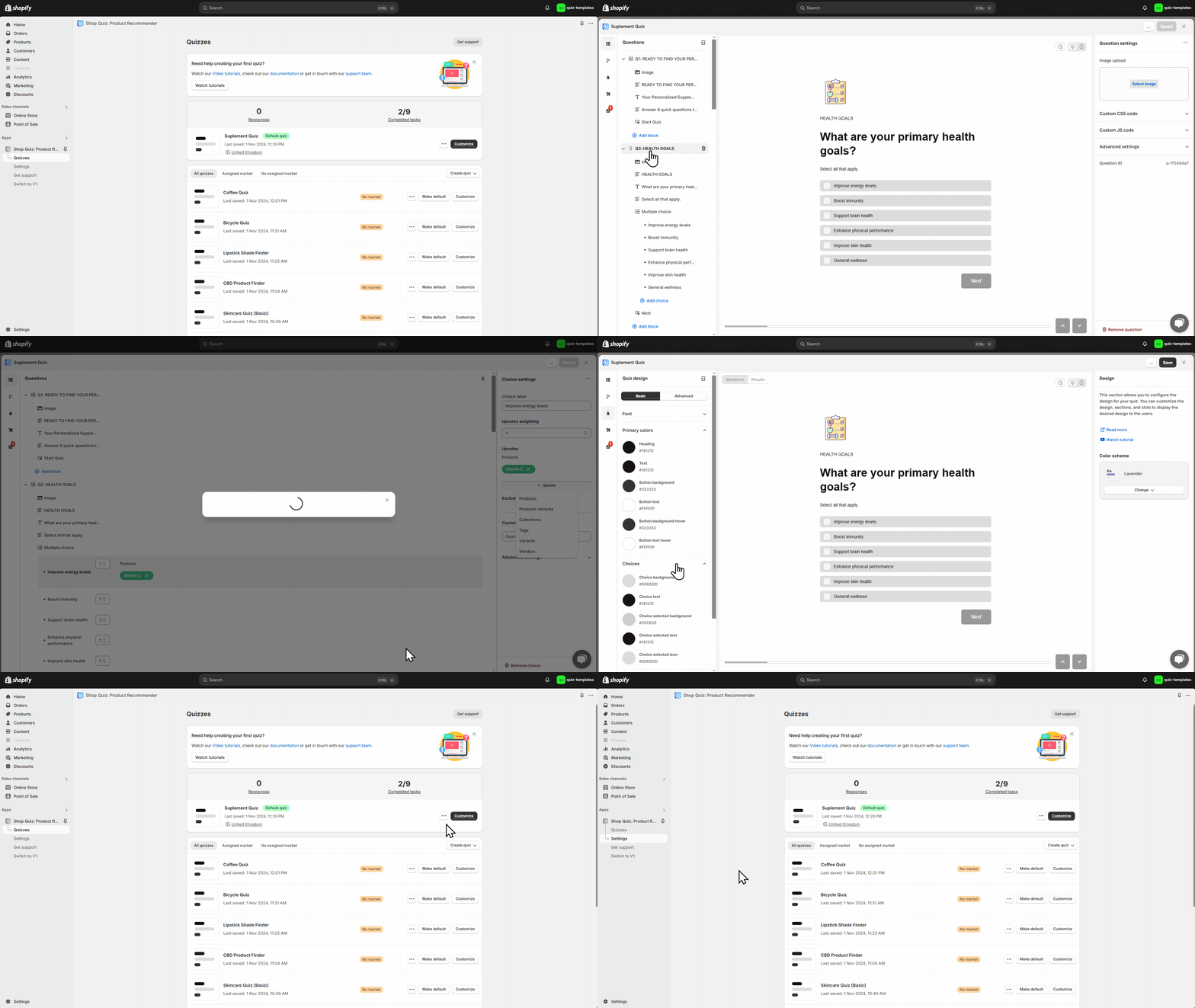
From the Dashboard, click Add New Quiz to start from scratch, use Quiz Copilot (the in-app AI assistant) to generate a quiz from a single prompt, or pick a pre-designed template. The Success Checklist on the left tracks your progress through the build.
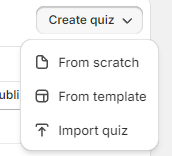
Templates from the RevenueHunt library cover skin type finder, routine builder, wellness goal matcher, supplement diagnostic, eyewear fit, sleep quiz and more. Starting from a template usually saves an hour and produces a stronger first draft than starting from a blank canvas.
Inside the Quiz Builder, click the Add Question button to insert a question, then pick the question type. Click any question card to open the right-side settings panel and adjust options (make a question optional, allow multiple answers, add a description or image).
- Multiple choice for skin type, primary concern, preference data
- Picture question for visual self-identification (hair texture, skin tone, room style)
- Name question for personalisation (the answer can be recalled later in the results page copy)
- Email question for lead collection (can be required or optional)
Drag and drop questions to reorder them.
A few patterns that consistently work from platform data across 20,000+ stores (benchmark report):
- 6 to 12 questions is the sweet spot. Quizzes with 9 to 12 questions convert at 11.0%, 6 to 8 at 10.4%, and 1 to 5 actually underperform at 9.8%. Shorter is not always better, a 3-question quiz feels superficial; the diagnostic depth is what builds confidence in the recommendation.
- 3 to 6 answer choices per question. Fewer feels too binary; more recreates the choice paralysis the quiz is meant to solve.
- Start linear, branch later. Most top-converting quizzes are completely linear (every shopper sees every question). Conditional logic only adds value where it eliminates genuinely irrelevant questions.
For the full data-backed playbook on quiz design, see our guide on how to build a successful product recommendation quiz.
Step 3: link products to answers
The recommendation engine works as a voting system. Each answer choice you map to one or more products contributes a “vote” toward those products. The results page sorts products by vote count, surfacing the best-fit matches at the top.
Open the settings panel for each answer choice, click the Upvote section, then add products or collections from your Shopify catalogue. With the Built for Shopify version, you can also recommend whole collections instead of individual SKUs, useful for stores with large or rotating inventory. For routine or bundle quizzes, group products into slots so the results page presents one product per step (cleanser, serum, moisturiser).
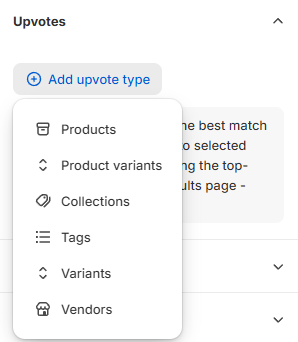
Map every answer choice. This is the single most common omission and one of the highest-impact fixes for a new quiz. Unmapped answers mean the recommendation engine has a blind spot. A customer who selects “sensitive skin” and receives the same recommendation as someone who selected “oily skin” will immediately distrust the result. Audit your answer-to-product mappings before you publish.
Step 4: design and customise
The Built for Shopify version automatically inherits your theme’s typography, colours and button styles, so the quiz looks like part of your store from the first render. For deeper control, open the Design tab. You get:
- The Theme Gallery with pre-made colour schemes
- A custom theme editor for fonts, background colours, button styles, and choice styles
- Background images per slide
- Custom CSS for full brand alignment on higher-tier plans
- Reusable themes you can save once and apply to future quizzes
Click Save to apply changes. The auto-inherit means most stores never need to touch the Design tab beyond a quick preview, which is the right outcome: the quiz should feel native, not bolt-on. For proven design patterns from quizzes that sell without any customisation, see the docs guide on best-converting quizzes.
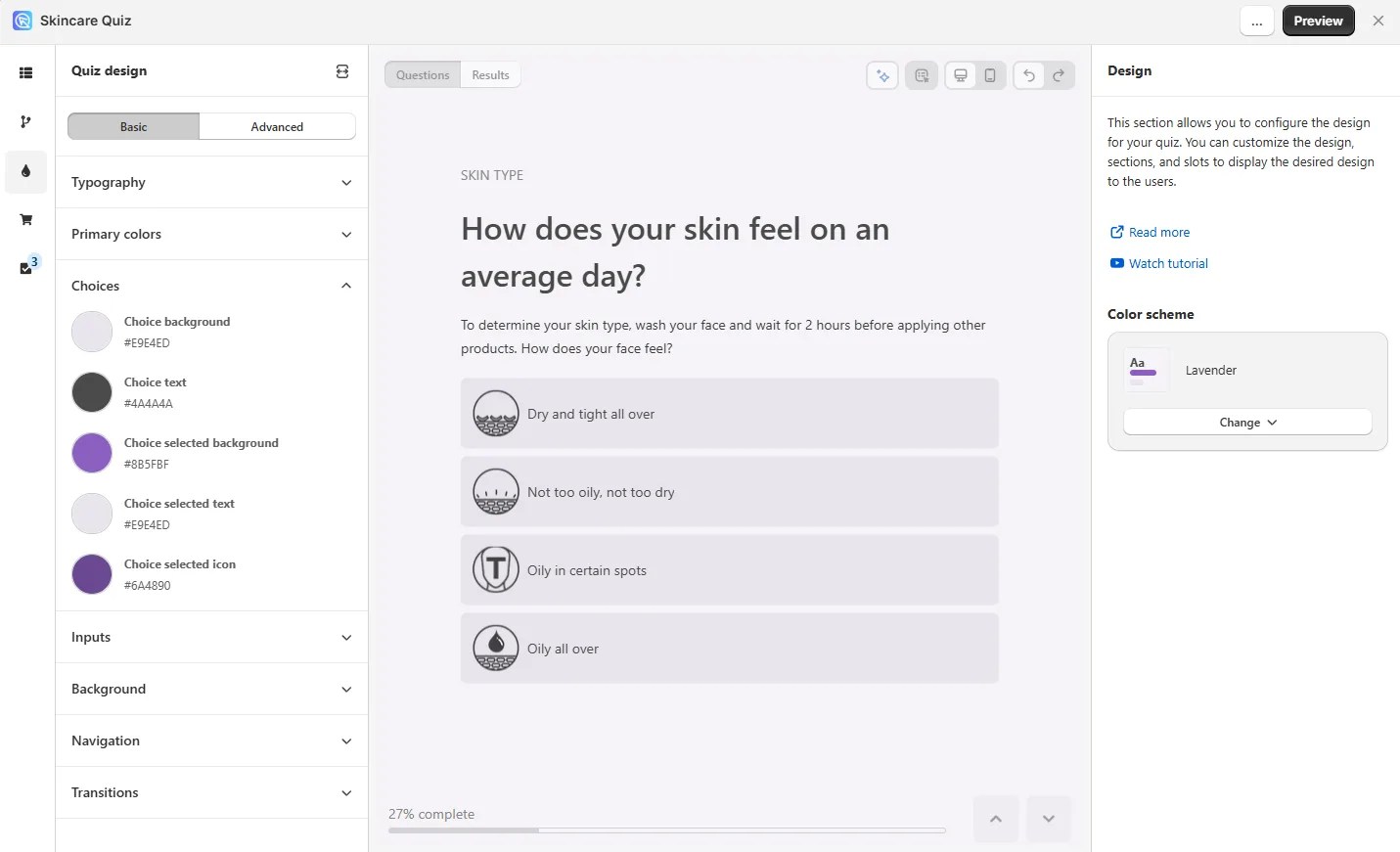
You can also customise the Results Page itself: click Add Block to insert text blocks for product information, image blocks for branding, or a Products block to set the recommendation count.
Step 5: publish on your store
Set the quiz as the default from the Dashboard, then open the Publish section to pick the publishing mode. Multiple options are available, pick the one that matches your distribution plan.
- Native theme block (inline). Embed the quiz directly on your homepage, collection or product detail page. The block sits in the Shopify theme editor at Online Store → Themes → Customize, so you drag it where you want it and the quiz loads as part of your theme.
- Link Popup Quiz. Activate the “Link Popup Quiz” app embed under Online Store → Themes → Customize → App Embeds, then add a menu item under Content → Menus with the title “Take our Quiz” and link
#quiz. The quiz opens in a polished popup from any nav click. - Automatic popup. Triggered on exit intent, scroll depth or time delay.
- Floating button. A persistent CTA that follows the user across the page.
- Standalone link. For paid ads, email or social sharing.
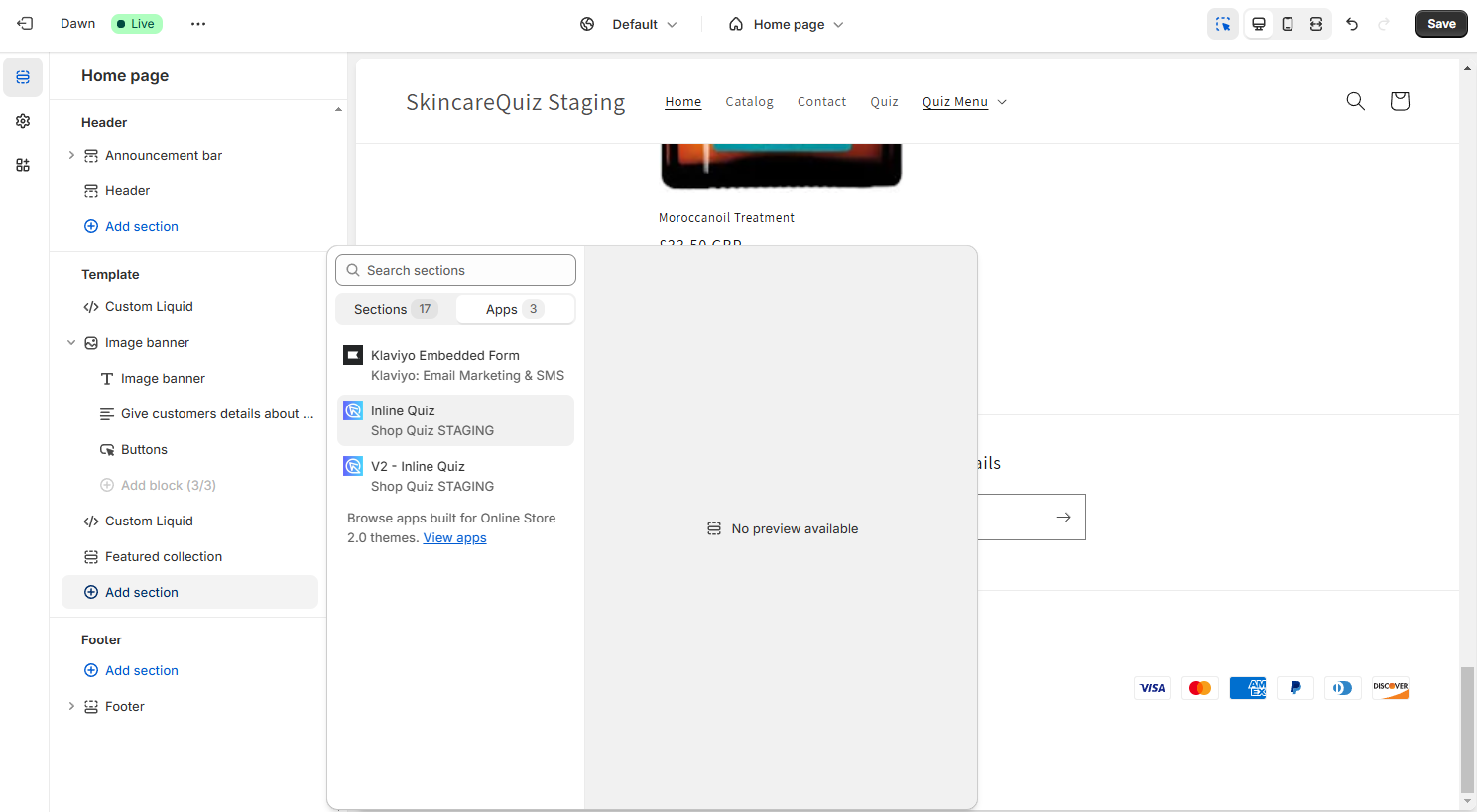
The App Settings panel lets you set the default quiz per Shopify market and language, which is essential for multi-region stores. Configure quizzes per market so European visitors see the EU quiz with euro pricing and EU product availability automatically. For step-by-step setup of each publishing mode, see the getting-started tutorial and the making your first quiz guide.
Step 6: drive traffic to the quiz
A published quiz that nobody finds is the most common failure mode for new quiz funnels. Treat the quiz as a primary CTA, not a hidden feature.
- Homepage hero block. “Find your perfect routine in 60 seconds” consistently outperforms a generic “Shop now” hero.
- Main navigation link. Highest-visibility placement available without paid traffic.
- Paid ads to a quiz landing page. Quiz funnels convert 30%+ better than collection pages as paid-ad destinations because they resolve decision fatigue at the moment of arrival. The Meta side is covered in how to make your Facebook ads smarter with quiz audiences.
- Email broadcast to your existing list. Subscribers who complete the quiz retroactively enrich their Klaviyo profile, which makes every future segmented campaign perform better.
- Discount on the results page. A 10-15% discount rewards completion and removes the last barrier to purchase.
For a full 11-placement breakdown, see our guide on how to promote your product recommendation quiz.
Native integrations
The Built for Shopify version syncs natively to the platforms that matter most for Shopify operators:
- Klaviyo. Quiz answers sync as custom properties in real time. No Zapier, no middleware. Powers segmented welcome, replenishment and win-back flows.
- Omnisend. For brands running combined email + SMS flows.
- Shopify Discounts. Apply your existing discount codes directly inside the quiz results page.
- GA4 and Meta Pixel. Quiz events fire to both analytics platforms automatically for attribution and audience building.
- Recharge. For subscription brands.
- Product metafields. Read structured product data into the recommendation logic.
- Shopify Markets. Region-aware quizzes with localised currency, language and product availability.
- Webhooks. For custom workflows.
Mailchimp, ActiveCampaign and HubSpot are on the roadmap for the Built for Shopify version. For the in-app email sender that ships with the app (useful before you connect a full ESP), see send quiz results emails on Shopify, WooCommerce and more.
Why a Shopify quiz works: zero-party data and guided selling
The conversion lift is the visible benefit. The structural benefit is the data the quiz collects.
Zero-party data. Every quiz answer is information the customer intentionally shared. Unlike behavioural data (inferred from clicks) or third-party data (purchased from intermediaries, increasingly unavailable), zero-party data is explicit, accurate and privacy-compliant. The full picture of how this data category compounds is in our zero-party data guide and first-party data guide.
Guided selling. A quiz replicates the in-store consultation that made premium retail work for decades: ask the right questions, listen to the answers, recommend a specific solution. Online stores that rely on a catalogue + search bar convert at 1-3%; stores that use a quiz funnel routinely hit 10-25% on cold traffic.
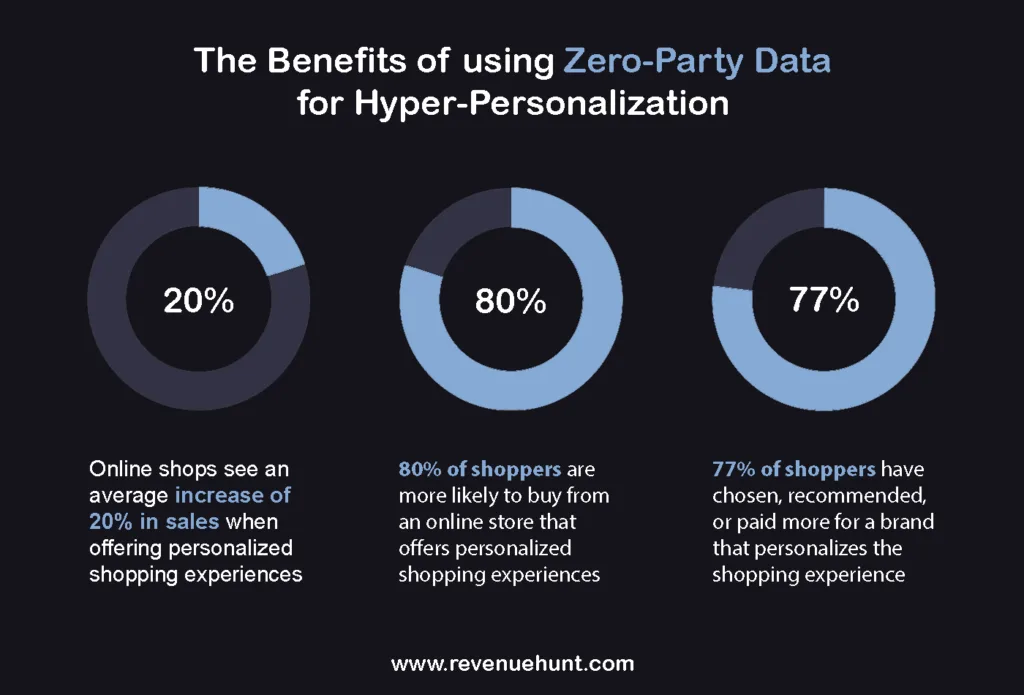
The data the quiz collects then flows to Klaviyo as custom properties, where it powers segmented welcome flows, replenishment reminders and win-back sequences that compound into lifetime value. For the full mapping chain, see how Klaviyo segmentation unlocks once zero-party data lands in profiles. For the strategic framing of where the quiz fits in a complete funnel, see our step-by-step funnel build guide and guided selling for eCommerce.
Get started
Install RevenueHunt: Recommender Quiz for Shopify and the quiz is live the same day. Free plan available.
For deeper tutorials, see getting started, making your first quiz, and the Built for Shopify customer success guide. For 11 real funnels that put the playbook into practice, see our real funnel examples.
Free tools & data
Put these benchmarks to work on your own store.
Free tool
Quiz ROI calculator
Estimate the extra revenue and ROI a product recommendation quiz could add to your store. Built on real data, no email required.
Calculate your ROIFree report
Ecommerce quiz benchmark report
How product recommendation quizzes really perform: conversion by category, AOV uplift, and completion, from 45M+ real quiz responses.
Read the report
Most shoppers leave because they can't find the right product