
First-party vs third-party data: what's the difference
First-party vs third-party data compared on ownership, accuracy, durability, and privacy, and why first-party wins as cookies disappear in 2026.
First-party data is customer information your brand collects and owns directly (orders, site behaviour, email engagement, stated preferences). Third-party data is aggregated or inferred by an intermediary you don’t own (data brokers, ad networks, look-alike models) and licensed back to you. The practical difference is durability: one category compounds in value and survives privacy regulation, the other is collapsing as cookies are deprecated.
This is a focused comparison of those two categories. For the full strategic picture, the seven channels that collect it, and how to activate it, see the complete first-party data guide. For the declared subset that sits inside first-party, see the zero-party data guide.
Key takeaways
- Ownership is the dividing line: first-party data you collect and own; third-party data you rent from an intermediary.
- Accuracy: first-party data is exact and customer-level; third-party data is inferred and probabilistic.
- Durability: first-party data compounds and survives privacy changes; third-party data is collapsing as cookies are deprecated.
- Privacy: first-party data is the easiest category to keep compliant; third-party data carries the consent-chain risk regulators scrutinise.
- What to do: replace rented third-party reach with owned first-party depth, collected through quizzes, post-purchase surveys, and accounts.
Fig. 01 The two categories sit at opposite ends of every dimension that matters. First-party data is owned, exact, durable, and easy to govern. Third-party data is rented, inferred, degrading, and the category regulators scrutinise hardest.
What is first-party data?
First-party data is everything a customer’s interaction with your business produces, stored on infrastructure you control: orders, basket composition, lifetime value, pages visited, search queries, email opens, SMS replies, customer-service tickets, and the preferences a shopper tells you directly through a quiz or survey. The defining property is ownership. You collected it, you store it, and you can use it without paying an intermediary for access or renegotiating renewal terms.
Because you own the full lifecycle, first-party data is the foundation every other marketing capability rests on in 2026. For the seven channels that collect it on a Shopify store and where to activate it, see how to build a first-party data program.
What is third-party data?
Third-party data is information you didn’t collect and don’t own. It’s aggregated, inferred, or purchased from an intermediary: data brokers, ad networks, and the look-alike and interest models that ad platforms build from cross-site tracking. A typical third-party signal is a probabilistic label like “female, 25 to 34, likely interested in skincare,” assembled from browsing behaviour the customer never knowingly shared with you.
For two decades third-party data powered cheap, broad targeting. That era is ending. The cookies and identifiers it depends on are being switched off at the browser and operating-system level, and the regulatory cost of using it keeps rising.
First-party vs third-party data: the head-to-head
| Dimension | First-party data | Third-party data |
|---|---|---|
| Who collected it | Your brand, on your own infrastructure | An intermediary you don’t own |
| How you get it | Customers interact, declare, and transact with you | Bought or licensed from brokers and ad networks |
| Accuracy | Exact and customer-level | Inferred and probabilistic |
| Durability | Highest, compounds with every interaction | Lowest, degrading with cookie deprecation |
| Cost structure | Upfront effort to collect, near-zero marginal cost after | Recurring licence fees, rising as supply shrinks |
| Privacy exposure | Easiest to govern, you control consent and deletion | High, you inherit someone else’s consent chain |
| Best use | Personalisation, retention, durable look-alike seeds | Broad prospecting, fading in reach and reliability |
| Example | ”This customer bought twice and told us their skin is sensitive" | "This anonymous profile resembles people who buy skincare” |
The table makes the strategic point on its own: first-party data wins on every axis except one (the upfront effort to collect it). Third-party data’s single advantage was scale at low effort, and that advantage is the exact thing privacy changes are taking away.
The differences that actually matter
1. Ownership and control
With first-party data you control collection, storage, retention, and deletion end to end. With third-party data you inherit decisions made by someone else: how the data was collected, whether consent was valid, and when the source disappears. When a broker shuts down or an ad platform changes policy, your third-party audience evaporates. Your first-party records do not.
2. Accuracy
First-party data is what the customer actually did or actually said. Third-party data is a guess. “Bought our sensitive-skin serum twice” is a fact. “Resembles a sensitive-skin shopper” is a model output that may be wrong, stale, or built on a different person entirely. For personalisation, the difference between fact and guess is the difference between a relevant message and a wasted one.
3. Durability
This is the decisive one in 2026. Third-party cookies are blocked by default in Safari’s Intelligent Tracking Prevention and Firefox’s Enhanced Tracking Protection, and reworked in Chrome under the Privacy Sandbox, so cross-site tracking now reaches a fraction of the audience it once did. Apple’s App Tracking Transparency cut the mobile signal further. First-party data is immune to all of this, because it never depended on cross-site identifiers. Better still, it compounds: every order, quiz answer, and email open enriches the same profile.
4. Privacy and consent
First-party data is the easiest category to keep compliant under GDPR, CCPA and CPRA, Quebec’s Law 25, and the growing patchwork of US state laws, because you control the consent at the point of collection and can honour access and deletion requests directly. Third-party data carries the opposite risk: you’re relying on a consent chain you didn’t witness, which is exactly what audits scrutinise.
5. Cost over time
Third-party data is a recurring cost that buys less every year as supply shrinks and reach falls. First-party data is an upfront investment in collection infrastructure that then runs at near-zero marginal cost. Once a quiz or a post-purchase survey is live, every additional response is essentially free and the dataset only gets richer.
Where does zero-party data fit?
Zero-party data is not a fourth rival category, it’s the most valuable slice of first-party data. The distinction is intent: most first-party data is observed (pages visited, products bought, emails opened), while zero-party data is declared (the customer explicitly tells you their skin type, budget, or who they’re shopping for). Both are owned by you, governed the same way, and equally durable.
That declared layer is the highest-leverage thing you can collect, because it captures intent you could never reliably infer from behaviour. A product recommendation quiz is the highest-yield way to gather it: it captures contact, consent, and structured preferences in one flow. For the patterns real brands use, see 12 zero-party data examples, and for the activation playbook, turning quiz answers into Klaviyo revenue.
What to do about it: replace third-party reach with first-party depth
The migration is not theoretical, it’s a sequence most Shopify stores can run in weeks:
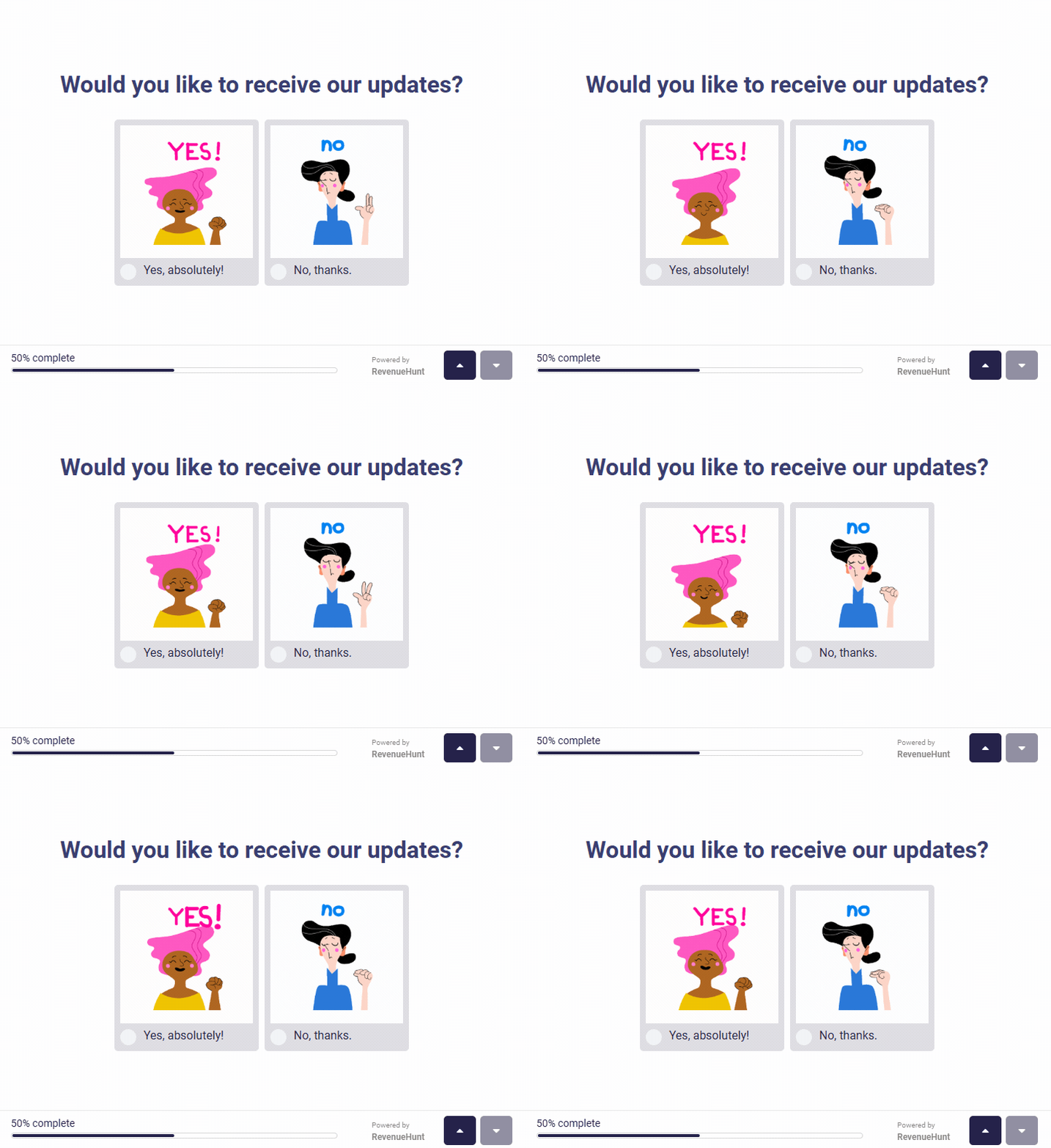
- Capture declared preferences at the top of the funnel. A quiz turns anonymous paid traffic into a named profile with stated intent, instead of paying a broker to guess at that intent. The platform benchmark across 20,000+ Shopify stores puts the median quiz around 69% completion. See the ecommerce quiz guide for the format and six recommendation systems compared for the mechanics.
- Enrich the profile after the sale. A two-question post-purchase survey captures attribution and intent in a high-goodwill window, attached directly to the order record.
- Activate it where third-party data used to sit. Mapped to custom properties in Klaviyo, Omnisend, or Mailchimp, first-party signals drive conditional flows, dynamic content, and far better look-alike seeds than any rented audience.
- Re-spend on retention. First-party data’s compounding advantage shows up most in repeat-purchase economics. See the customer retention guide for where this data pays back.
The brands that have a working first-party program by mid-2026 compound an advantage that brands still renting third-party signals can no longer access. To estimate what stated-preference personalisation could add to your store, use the quiz ROI calculator, or install RevenueHunt free on Shopify.
Frequently asked questions
What is the difference between first-party and third-party data?
First-party data is customer information your brand collects and owns directly on its own infrastructure: orders, site behaviour, email engagement, and stated preferences. Third-party data is aggregated or inferred by an intermediary you don’t own (data brokers, ad networks, look-alike models) and licensed back to you. First-party data is exact, durable, and easy to govern; third-party data is probabilistic, degrading with cookie deprecation, and carries higher privacy risk.
Is first-party data better than third-party data?
For personalisation, retention, and durable targeting, yes. First-party data is exact rather than inferred, it compounds with every interaction, and it survives cookie deprecation and privacy regulation. Third-party data’s only historical advantage was cheap scale, and that advantage is shrinking fast as browsers block cross-site tracking. Third-party data still has a narrowing role in broad prospecting, but it can no longer be the foundation of a marketing program.
Is zero-party data the same as first-party data?
Zero-party data is a subset of first-party data. Both are collected and owned by your brand. The difference is intent: first-party data is typically observed (what the customer did), while zero-party data is declared (what the customer explicitly told you). Governance-wise they live under the same umbrella, which is why a deletion or consent request covers both.
Why is third-party data going away?
Three forces at once. Third-party cookies are blocked by default in Safari and Firefox and restricted in Chrome, so cross-site tracking reaches a fraction of its former audience. Apple’s App Tracking Transparency cut the mobile signal. And privacy laws (GDPR, CCPA and CPRA, Quebec’s Law 25) have made the consent chain behind brokered data a regulatory liability. The reach falls while the cost and risk rise.
Can I still use third-party data in 2026?
Yes, but with realistic expectations. It still has a role in broad prospecting and reach extension, and “clean room” and aggregated-measurement products preserve some of its measurement value. The mistake is depending on it for personalisation or treating it as a stable foundation. Use it as a narrowing supplement, and shift your investment toward first-party collection.
How do I collect first-party data instead?
Seven channels work consistently on a Shopify store: customer accounts and accelerated checkout, email and SMS sign-ups, product recommendation quizzes, post-purchase surveys, loyalty programs, customer-service touchpoints, and on-site analytics. Quizzes produce the highest yield of structured preference data per minute of customer attention. The full breakdown is in the first-party data guide.
What is second-party data, and how is it different?
Second-party data is simply another brand’s first-party data, shared with you through a direct partnership or co-marketing agreement. It can be useful for audience expansion, but its quality depends entirely on the partner’s collection practices and consent chain, which makes it less reliable than data you collected yourself.
Free tools & data
Put these benchmarks to work on your own store.
Free tool
Quiz ROI calculator
Estimate the extra revenue and ROI a product recommendation quiz could add to your store. Built on real data, no email required.
Calculate your ROIFree report
Ecommerce quiz benchmark report
How product recommendation quizzes really perform: conversion by category, AOV uplift, and completion, from 45M+ real quiz responses.
Read the report
Most shoppers leave because they can't find the right product