
Extreme Kids World case study: 76.9% completion, $3K AOV niche quizzes
How three niche Shopify quizzes at Extreme Kids World hit 76.9% completion, drove +160% growth in quiz starts year-over-year, and ~$3K average cart value.
Three niche quizzes replaced a catalogue grid as the primary discovery surface at Extreme Kids World, a Shopify retailer selling outdoor playsets, trampolines, wall bars and sensory tools. The narrowest of the three (Wall Bars) completes at 76.9%. The broadest (Outdoor Wooden Playset) completes at 46.6%. Same store, same audience, same builder. Scope was the only variable.

Fig. 01 Extreme Kids World runs three niche quizzes covering distinct catalogue branches: outdoor playsets, wall bars, and vinyl playhouses.
What you'll learn
- →Why three focused quizzes outperformed one general catalogue-style recommender for high-AOV outdoor play equipment.
- →The ~7-step funnel shape (introduction, constraints, preferences, budget, optional email, results) that runs across all three quizzes.
- →The disclosed 90-day numbers: +160% growth in quiz starts, +183% growth in responses, ~$3K average cart value, 76.9% completion on the narrowest quiz.
- →How the same Klaviyo and HubSpot integrations turn quiz answers into months-long retention flows on a once-every-few-years purchase.
- →Four lessons other DTC brands can apply to their own high-consideration catalogues.
90-day disclosed results across the three quizzes
76.9%
niche quiz completion
Wall Bars completes at 76.9% vs 46.6% on the broader Outdoor Wooden Playset quiz. The narrower the scope, the higher the completion.
+160%
quiz starts YoY
Outdoor Wooden Playset Quiz, 90-day window vs prior 90 days. Responses up +183%, carts up +109%, cart value up +82%.
$3K AOV
average cart value
Outdoor playset quiz carts average ~$3,000. Wall Bars averages ~$1,300. High-consideration purchase, with the quiz doing the qualifying work.
01 · Executive summary
Three niche quizzes beat one mega-quiz
Extreme Kids World runs a catalogue of high-consideration, high-AOV outdoor and indoor play equipment. The categories are distinct: a parent buying a wooden playset is a different shopper than a parent buying wall bars, who is a different shopper again from a parent buying a backyard vinyl playhouse. Their constraints are different (yard size vs ceiling height vs interior wall space), their budgets are different (~$3,000 average for outdoor playsets vs ~$1,300 for wall bars), and their question sets are different. So the brand built three separate quizzes instead of one combined one. The strategic premise (focused quizzes outperform mega-quizzes on conversion-rate and on completion) is the same argument the polished pillar piece quiz funnels vs collection pages makes in the abstract. This article is the worked example.
Case at a glance
| Brand | Extreme Kids World, founded by Shani Tapia |
| Vertical | Outdoor playsets, trampolines, wall bars, indoor sensory tools |
| Platform mix | Shopify, running a mix of the Built for Shopify version (one quiz) and the Shopify Legacy version (the other two) |
| Quizzes published | 3 niche quizzes covering distinct catalogue branches |
| ESP / CRM connected | Klaviyo, with HubSpot wired into the highest-AOV quiz |
| Quiz architecture | A consistent ~7-step funnel skeleton across all three quizzes, with category-specific question content |
| Flagship quiz growth (90 days) | +160% growth in quiz starts year-over-year, +183% in responses, +109% in carts |
| Completion rate gap | 76.9% on the narrowest niche quiz vs 46.6% on the broadest |
| Average cart value range | Roughly an order of magnitude apart between the highest-AOV outdoor quiz and the lower-AOV indoor quiz |
| Drop-off rate on the cleanest funnel | ~4.5% end-to-end |
| Data source | Built for Shopify RevenueHunt Analytics dashboard for the Built for Shopify quiz; Shopify Orders integration on the Legacy quizzes (see first-party Shopify quiz analytics for the Legacy attribution model) |
Key results, 90-day period
| Metric | Broader outdoor quiz | Narrower niche quiz |
|---|---|---|
| Completion rate | 46.6% | 76.9% |
| Quiz starts YoY | +160% | n/a (smaller cohort) |
| Responses YoY | +183% | n/a |
| Carts YoY | +109% | +13% |
| Cart value YoY | +82% | +109% |
| ESP / CRM connected | Klaviyo | Klaviyo + HubSpot |
Verified via the Built for Shopify RevenueHunt Analytics dashboard on the Built for Shopify quiz, and via the Shopify Orders integration on the Legacy quizzes.
02 · The brand
Outdoor and sensory play for high-energy families
Extreme Kids World specialises in products for high-energy and sensory-driven children: outdoor playsets in wood, vinyl, poly and metal; trampolines; indoor wall bars; sensory regulation tools like bubble tubes and sensory tunnels. The brand was founded by Shani Tapia, a mother of three energetic children, after she realised the market underserved parents looking for play equipment that combined high-energy outlets with sensory regulation.
“Honestly, the whole reason I started Extreme Kids World is because I’ve been there. If we didn’t find positive ways for them to move and get that sensory input they craved, we were all going to lose it. What if I could help other parents solve the same problem?”
The catalogue spans outdoor playsets (Congo Playsets, Skywalker Trampolines, 2MamaBees Playhouses, Bijou Build), indoor wall bars, vinyl playhouses, and sensory tools. Price points run from a few hundred dollars for sensory tools to several thousand dollars for outdoor playsets. The brand sells on Shopify and uses email and CRM follow-up (Klaviyo, HubSpot) to convert the long-tail of shoppers who research now and buy weeks or months later.
03 · The challenge
High-AOV catalogue, low-context shopper
Outdoor play equipment is a high-consideration purchase. A wooden playset averages around $3,000 at this brand; the customer has constraints (backyard size, terrain, climate, number of children, age of children, budget) that they cannot easily resolve by browsing a product grid. The catalogue itself is broad enough that asking the shopper to self-select between an outdoor playset, a vinyl playhouse and an indoor wall bars station forces three completely different question sets onto the same flow.
The three core challenges:
- The catalogue is too broad to be its own filter. A vinyl-playhouse shopper doesn’t care about ceiling height; a wall-bars shopper doesn’t care about backyard dimensions. A general “find your product” quiz has to ask about both, which means every shopper answers questions that don’t apply to them.
- The AOV is too high for impulse browsing. At $3,000+ for an outdoor playset, the customer wants a confident recommendation before they spend. A catalogue page asks them to self-diagnose; a quiz can do the diagnosing for them.
- A significant share of buyers are gift-givers. Grandparents, relatives and friends buying for a child they don’t see daily can’t reliably guess the child’s energy level, available yard size or age-appropriate equipment. They need a quiz framed for them, not for the parent.
A single mega-quiz spanning all three product lines would either over-question every shopper or under-question some of them. Neither converts.
04 · The strategic decision
Three niche quizzes, not one mega-quiz
Rather than build one generalist quiz that routes shoppers across the entire catalogue, the brand built three separate niche quizzes covering distinct catalogue branches:
- A broader outdoor playset quiz for the highest-AOV product line, covering backyard, space, children, play preferences and budget.
- A narrower wall bars quiz for the indoor product line, scoped to wall-space, ceiling height, child age, target activity and budget.
- A vinyl playhouse quiz for the mid-AOV product line, scoped to backyard placement, available space, children and budget.
Each quiz lives at its own URL and is promoted contextually (a customer searching for “wall bars” never sees the playset quiz, and vice versa). All three sync answers to Klaviyo as zero-party data; the wall bars quiz additionally syncs to HubSpot for sales hand-off on the highest-AOV configurations.
The platform split is mixed: the vinyl playhouse quiz runs on the Built for Shopify version of RevenueHunt (which connects to Shopify Orders automatically for revenue attribution). The outdoor playset and wall bars quizzes still run on Shopify Legacy and use the Legacy Shopify Orders integration for revenue attribution, with the Legacy same-session attribution caveat in play. No developer involvement was needed for any of the builds or for ongoing maintenance.
For the broader case for why this beats a paid-traffic-into-catalogue-page funnel, see quiz funnels vs collection pages. For the popup-vs-quiz lead-capture pillar, see why popups are walls and quizzes are doors.
05 · The implementation
A consistent funnel skeleton, adapted per niche
All three quizzes share a consistent funnel shape that maps cleanly onto the kind of constraints high-consideration play equipment imposes: a brief introduction, a handful of constraint questions (where the product will live, how much space is available, who will use it), a preference signal, a budget filter, an optional contact step, and a single confident recommendation on the results page. Total length is in the high single digits per quiz.
The exact wording and the order of the constraint questions are tuned per product category. A wall-bars quiz asks about ceiling height and wall span; a vinyl playhouse quiz asks about backyard placement. The skeleton is the same; the questions are different.
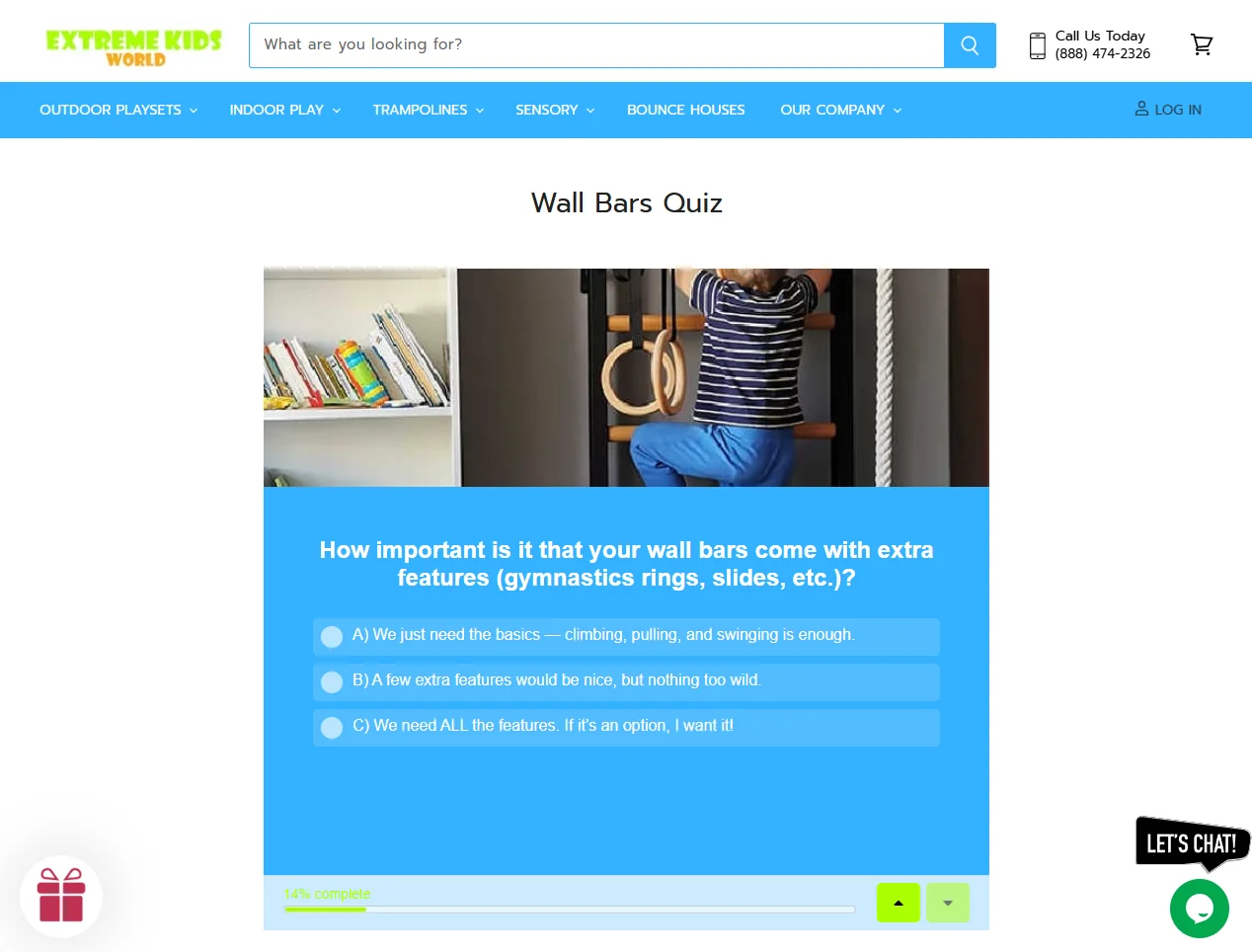
Fig. 03 The wall bars quiz interface. Every question is scoped to wall-bars-specific constraints. The same funnel skeleton runs on the playset quizzes with category-specific question content.
5.1 The recommendation distribution as a marketing signal
Each quiz routes to a small set of matched products. The recommendation distribution that emerges (which products end up in front of how many shoppers) is the kind of demand-intelligence signal a collection page never surfaces. On the cleanest of the three funnels, a single product captures a clear majority of recommendations; the rest are spread across four alternates. The brand uses that distribution to inform inventory holds, ad creative priorities, and email follow-up sequencing, none of which a passive catalogue grid can suggest.
5.2 Drop-off performance
The cleanest of the three quizzes holds a roughly 4.5% end-to-end drop-off rate. Nearly every shopper who starts the funnel continues through each subsequent constraint question; the only meaningful drop-off happens around the optional email step. The tight scope of each quiz is doing the work: shoppers who entered a niche-specific quiz are pre-qualified to be in-market for that category, and nearly all of them stay through the recommendation.
5.3 ESP and CRM integration
All three quizzes sync to Klaviyo as zero-party data on every completion that captures an email. The wall bars quiz also syncs to HubSpot, which fits the higher-AOV configurations where a sales follow-up touch closes the loop. The data flowing into both is the same: quiz name, response ID, per-question answers (place / space / age / budget), recommended product IDs, assigned tags. Every answer becomes a custom property the brand can segment on, which is what turns a one-time playset purchase into a multi-year retention relationship.
For the activation playbook on the Klaviyo side, see your Klaviyo list is a graveyard. For the HubSpot integration walkthrough, see HubSpot quiz integration.
06 · The results
90-day performance data
6.1 Headline metrics
| Metric | Outdoor playset quiz | Wall bars quiz | Vinyl playhouse quiz |
|---|---|---|---|
| Quiz starts | +160% YoY | smaller cohort | +224% YoY |
| Responses | +183% YoY | smaller cohort | +215% YoY |
| Completion rate | 46.6% | 76.9% | high (~4.5% drop-off) |
| Carts | +109% YoY | +13% YoY | n/a |
| Cart value | +82% YoY | +109% YoY | n/a |
The growth numbers in the table are a 90-day window vs the prior 90 days. The completion rate is the share of starts that reach the results page within the same 90-day window. Exact revenue figures are not disclosed in this case study.
6.2 The niche-vs-broader completion gap
The headline finding is the completion-rate gap between the narrower wall bars quiz and the broader outdoor playset quiz:
- Narrower niche quiz (wall bars): 76.9% of starts reach the results page
- Broader outdoor playset quiz: 46.6% of starts reach the results page
Same store, same audience, same builder, same time period. The only structural difference is that the wall bars quiz only has to ask about wall-bars-specific constraints, while the broader outdoor playset quiz has to cover a wider range of configurations. Narrower scope produces higher completion, with no other variable changed.
Fig. 02 Completion rate by quiz scope, same store. The narrower niche quiz completes at 76.9% vs 46.6% on the broader outdoor playset quiz. The 30-point gap is the cleanest empirical demonstration of the niche-quiz argument in the cluster.
For brands choosing between a single recommender and multiple niche quizzes, this is the cleanest empirical demonstration in the cluster: a 30-point completion-rate gap inside the same store.
6.3 Demand intelligence beyond conversion
Every quiz response is zero-party data: self-declared, consented, attached to the customer record. Beyond on-page conversion, the brand uses the data for:
- Inventory and ad creative priorities. The recommendation distribution emerging from the quizzes tells the brand which products to feature in paid ads and which to keep top-of-stock. A single product capturing a clear majority of recommendations is its own marketing brief.
- Segmented Klaviyo flows. Each quiz answer becomes a custom property. A parent shopping for a roomy outdoor space with multiple children gets a different welcome flow than a grandparent shopping for a compact indoor product as a gift. Long-tail value compounds; outdoor playsets are a once-every-few-years purchase, but the answers feed retention flows for years afterwards.
- HubSpot hand-off on highest-AOV configurations. When a wall bars quiz response indicates a high-budget configuration, the contact flows into HubSpot for a personal sales touch, recovering the small share of high-AOV deals that don’t close from email alone.
For the broader category context this all rests on, see first-party data. For the segmentation mechanics in Klaviyo specifically, see your Klaviyo list is a graveyard.
07 · What made it work
Four structural decisions that drove the results
7.1 Three niche quizzes, not one mega-quiz
The single largest decision was to split discovery into three category-specific quizzes instead of one generalist recommender. This is what produces the 76.9% vs 46.6% completion-rate gap. A niche quiz can ask the expert-level questions a generalist quiz can’t (wall-bars ceiling height, vinyl-playset backyard dimensions, wooden-playset age and number of children) without burdening the wrong shopper with the wrong questions.
7.2 One funnel skeleton, adapted per niche
All three quizzes share a consistent ~7-step skeleton. Building one funnel structure and adapting it per category turned out to be much faster to maintain than designing three bespoke flows. The skeleton also makes data comparison clean: completion rate, drop-off per step, and recommendation distribution can be compared across quizzes because they share the same shape.
7.3 Native Klaviyo and HubSpot integration on every completion
Every quiz answer flows to Klaviyo as a custom property without Zapier, without CSV exports, without middleware. The Wall Bars Quiz additionally flows to HubSpot. This means the brand can build segmented flows the moment a quiz launches, instead of waiting weeks for integration plumbing. Outdoor playsets are once-every-few-years purchases; the data captured on the first quiz visit continues to feed retention flows for years after the order ships.
7.4 First-party revenue attribution across two platform versions
The brand verifies the disclosed metrics through first-party sources rather than Pixel or GA4. The vinyl playhouse quiz runs on the Built for Shopify version and reports through the Built for Shopify RevenueHunt Analytics dashboard, which connects to Shopify Orders automatically with no configuration. The outdoor playset and wall bars quizzes still run on Shopify Legacy, where revenue is reported through the Legacy Shopify Orders integration with the same-session attribution caveat in play (the customer has to complete checkout in the same session for the order to attribute to the quiz). Both flows produce numbers the brand can read off the Shopify ledger directly rather than waiting for Pixel reconciliation.
Operating rule: first-party data is the source of truth for revenue. Pixel and GA4 are the source of truth for audiences and traffic. Mixing the two means reconciling numbers that were never meant to match.
08 · Lessons learned
What other brands can apply
- Run several niche quizzes, not one mega-quiz, when the catalogue spans distinct shopper jobs. A vinyl-playhouse buyer and a wall-bars buyer are different people with different constraints. Splitting them produced a 30-point completion-rate gap (76.9% vs 46.6%) inside the same store.
- Match the funnel to the buyer, not the catalogue. Half of high-AOV play equipment is bought as a gift. A gift-finder framing (recipient age, budget tier, occasion) converts gift-buyers better than a catalogue-shaped one. The gift finder solution walks through the mechanic.
- Treat every answer as the seed of a multi-year retention sequence. Outdoor playsets are once-every-few-years purchases. The customer who answered “child is 6, mid-range budget” today will be in market again when the child is 9; the brand that captured the answer is in position to make that next sale.
- Make the email step required if ESP integration is the goal. Optional email steps see the bulk of drop-off (~10% on the Vinyl Playset Quiz alone) and produce mostly empty contact records. Required email steps trade a few percentage points of completion for a meaningfully more useful Klaviyo and HubSpot pipeline.
- Use the recommendation-distribution data as a marketing brief. When the quiz logic puts a single product in front of a clear majority of shoppers, that’s a paid-ad and inventory signal a collection page can’t surface.
- High single digits is a clean upper bound for a high-consideration funnel. Past 8-9 questions, drop-off accumulates faster than the additional signal is worth. Within that bound, the constraints get captured with enough completion to keep the funnel commercial.
FAQ
Why does Extreme Kids World run three niche quizzes instead of one general recommender? Because narrow scope produces meaningfully higher completion. The Wall Bars Quiz, scoped to a single product category, completes at 76.9%. The Outdoor Wooden Playset Quiz, which covers a broader range of configurations, completes at 46.6%. Same store, same audience, same builder, same time period. The 30-point gap is the empirical answer: niche quizzes let you ask the expert-level questions a generalist quiz can’t.
What’s the funnel structure, and why ~7 steps? The shape across all three quizzes is consistent: a brief introduction, a handful of constraint questions, a preference signal, a budget filter, an optional email step, and a single confident recommendation on the results page. Around 7 steps total. Past 8-9 questions, drop-off accumulates faster than the additional signal is worth; under 5-6, the constraints aren’t fully captured. The cleanest of the three quizzes drops only ~4.5% of shoppers across the entire funnel, which is the tight scope doing the work.
How were the disclosed numbers verified? The quiz response counts, completion rates, drop-off rates and growth figures come from RevenueHunt’s first-party Analytics: the Built for Shopify dashboard on the Built for Shopify quiz, and the Legacy Shopify Orders integration on the two quizzes that still run on Shopify Legacy. Both flows read from the Shopify ledger rather than through the Meta Pixel or GA4. Exact revenue figures are not disclosed in this case study; the percentage growth metrics and completion rates are reported instead.
Can other DTC brands replicate this pattern below the $3K AOV? The structural lessons (niche quizzes, ~7-step funnel, native Klaviyo sync, multi-year retention framing) transfer directly. The 76.9% completion-rate finding is independent of AOV; it’s a function of scope. The lessons compound the most for high-consideration categories where the shopper genuinely can’t self-diagnose, but they apply across price points. For a worked example at a different price point and category, see the anti-ageing device case study (9.8% CVR on cold Meta traffic, +42.64% AOV lift, $691,128 in 90 days).
What about HubSpot specifically? The Wall Bars Quiz syncs to both Klaviyo and HubSpot. The brand uses HubSpot for sales hand-off on the highest-AOV configurations where a personal touch closes the loop. For the integration walkthrough, see HubSpot quiz integration.
Next steps
- For the disclosed-numbers companion in a different vertical: anti-ageing device case study (9.8% CVR, +42.64% AOV, $691K in 90 days).
- For the category context (the 5 quiz formats this case study fits inside): the umbrella guide.
- Read the strategic pillar behind this case study: quiz funnels vs collection pages, why your paid traffic bounces.
- Read the lead-capture pillar: why popups are walls and quizzes are doors.
- See 10 more funnel patterns in production: 11 ecommerce sales funnel examples.
- For the platform benchmark that anchors every number on this page: the state of product recommendation quizzes.
- Estimate the impact on your own store: quiz ROI calculator.
- Launch a quiz on Shopify (no code, native Klaviyo and HubSpot sync, free trial).
Free tools & data
Put these benchmarks to work on your own store.
Free tool
Quiz ROI calculator
Estimate the extra revenue and ROI a product recommendation quiz could add to your store. Built on real data, no email required.
Calculate your ROIFree report
Ecommerce quiz benchmark report
How product recommendation quizzes really perform: conversion by category, AOV uplift, and completion, from 45M+ real quiz responses.
Read the report

Most shoppers leave because they can't find the right product