
Why popups are walls and quizzes are doors: rethinking DTC lead capture
Your email list is big but dumb. Replace generic popups with a quiz that captures zero-party data, syncs to Klaviyo, and earns 3x revenue per recipient.
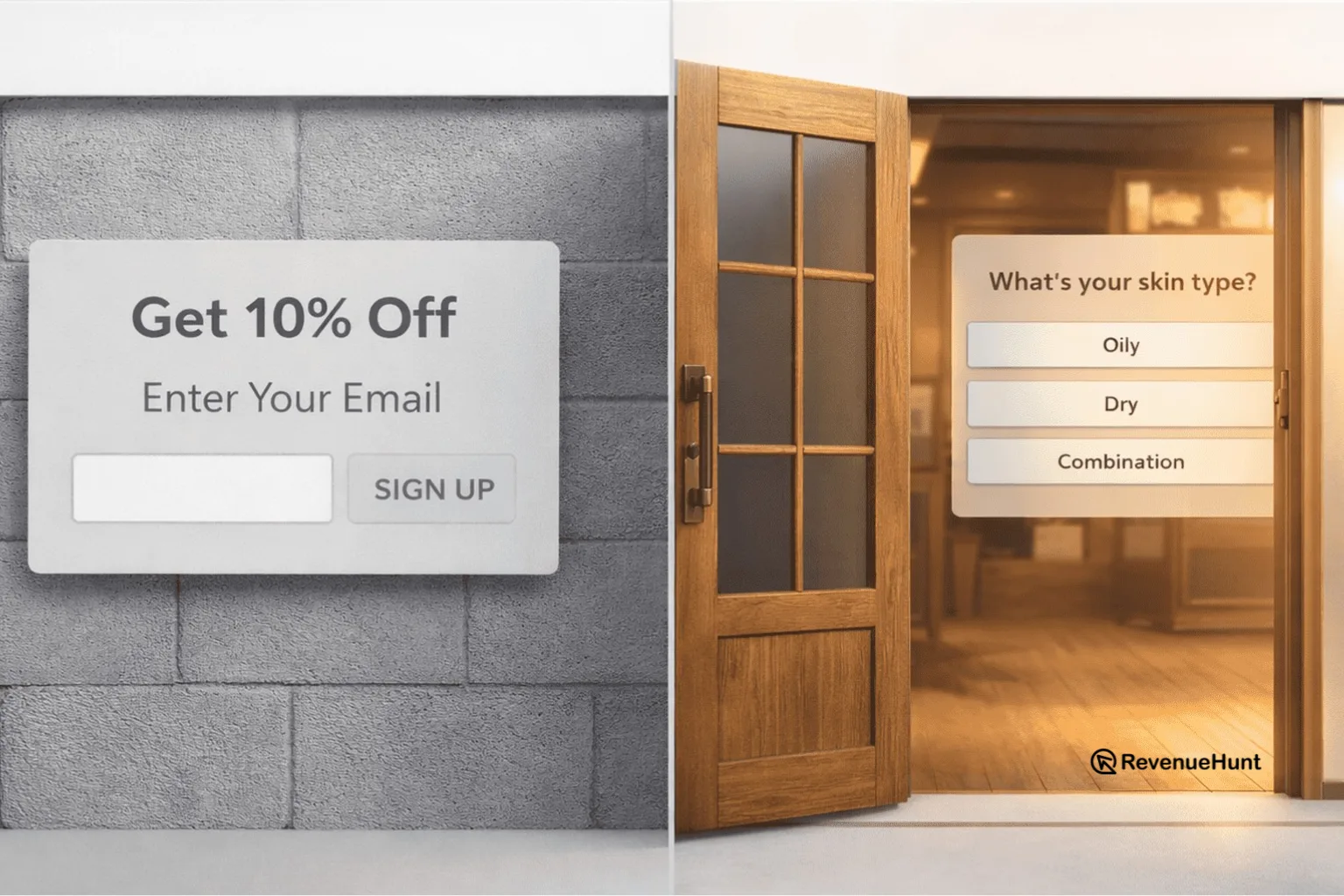
Fig. 01 A popup blocks the storefront like a wall, asking for an email before the shopper has any reason to give one. A quiz opens a door, offering value (a recommendation) in exchange for structured preferences.
The lead-capture paradigm shift: one model interrupts and extracts, the other invites and exchanges. Same storefront. Different architecture. Different results.
You’re staring at your Klaviyo dashboard at 9:14 AM on a Tuesday. The welcome-flow revenue chart is doing something it shouldn’t be doing: declining, month over month, for the fourth consecutive period. Your list has 53,000 subscribers. On paper, that looks like an asset. In practice, you know what it really is: a graveyard. Rows and rows of email addresses with no context, no skin type, no primary concern, no preference data of any kind. You send a campaign, 60% don’t open it, 3% click, and the unsubscribe count ticks up like a taxi meter.
The list is big. But it’s dumb. And a dumb list isn’t an asset; it’s an expensive liability that degrades your sender reputation with every blast you’re forced to send.
You know exactly how you got here. Every one of those 53,000 addresses entered through the same front door: a popup offering 10% off in exchange for an email. No diagnostic questions. No preference capture. No segmentation signal. Just a discount and an address. And now your Klaviyo account is full of profiles you can’t act on, because you have nothing to act on.
This isn’t a Klaviyo problem. It’s a lead generation quiz architecture problem. And the popup is where it starts.
What you'll learn
- →The four structural reasons the popup model breaks down: discount-hunter filtering, context vacuum, interrupt vs invite, and the blast doom loop.
- →Why "list intelligence" beats "list size" once revenue per recipient becomes the metric that matters.
- →The five-step quiz-to-Klaviyo pipeline, end to end, with the data shape that lands on each profile.
- →The Lead Quality Pyramid: where most DTC brands sit today, and what's possible at the top tier.
- →When the popup still has a role (it does, just not the role most stores give it).
List intelligence beats list size
71%
of top-converting quizzes collect email; 75% make it required (RevenueHunt benchmark, 45M+ responses)
3x
revenue per recipient on segmented Klaviyo campaigns versus generic blasts (Klaviyo segmentation benchmark)
1 in 5
quiz-attributed orders land more than 30 days later, so the segmentation layer keeps converting through email for months
The structural failure of the popup model
This isn’t a critique of any specific popup tool. The software works fine. The paradigm is broken, and it’s broken in four specific, cascading ways that compound over time.
The discount-hunter trap
A popup that says “Get 10% off, enter your email” is a filter. But it filters in the wrong direction. It selects for the most price-sensitive visitor, the one who was already comparison shopping, who will use the code, buy once at reduced margin, and never return. Meanwhile, the high-intent shopper, the one who came to your site with a genuine need and a willingness to pay full price, finds the popup annoying, closes it in 0.8 seconds, and continues browsing without ever entering your email ecosystem.
You’re paying for list growth that biases toward the least loyal customer type. The popup isn’t growing your list. It’s growing a list of discount hunters and filtering out your best prospects.
The context vacuum
Even when the popup captures an email successfully, it captures exactly one data point. The address. You now have a subscriber, but you know nothing about them. Are they shopping for acne solutions or anti-ageing? Sensitive skin or oily? Buying for themselves or as a gift? What’s their primary concern: texture, breakouts, pigmentation, hydration?
Without this context, every email you send is a guess. The deliverability layer is increasingly unforgiving on guesswork: ISPs now use per-mailbox engagement signals (open and click rates relative to your list size) as a primary input to whether a brand lands in the Inbox or in Promotions / spam.
The interrupt vs invite problem
Consider the architecture of a popup. It appears uninvited. It blocks the content the visitor came to see. It demands something, an email address, before it has offered anything of real value. A 10% discount isn’t value; it’s a bribe.
A popup is a wall between the customer and the store. It takes before it gives. This isn’t a design choice; it’s a fundamental UX flaw that has downstream consequences for everything: data quality, engagement rates, deliverability, and ultimately, LTV.
The blast doom loop
This is where the structural failure becomes a system failure.
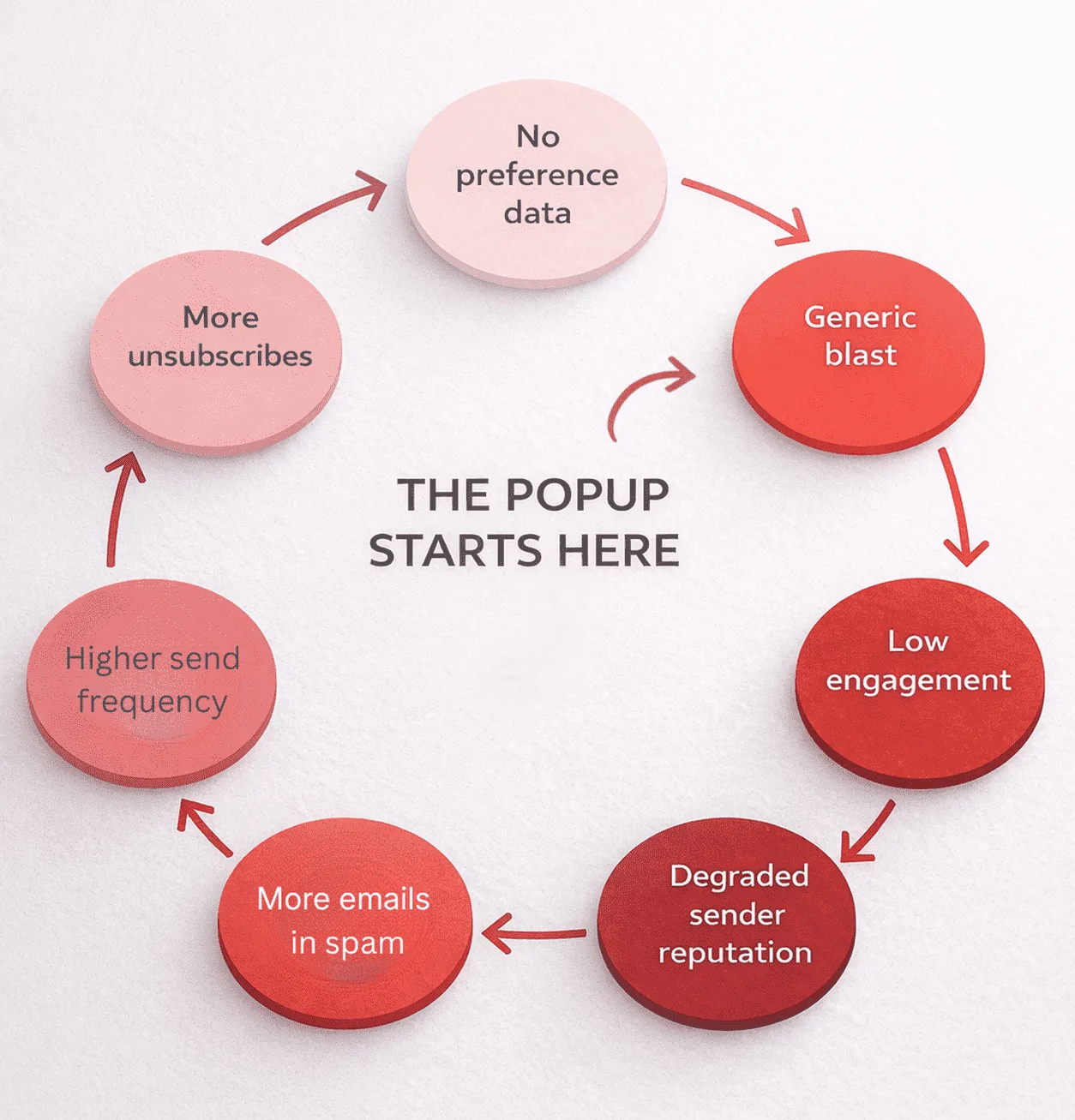
Fig. 02 The blast doom loop: no preference data leads to generic sends, engagement collapses, sender reputation degrades, inboxes mark blasts as spam, unsubscribes accelerate. Each cycle makes the next one worse.
Every generic blast accelerates the cycle. The popup is the entry point, and without preference data, there’s no exit.
The popup captures no preference data, so you’re forced to send generic campaigns to your entire list. Generic blasts produce low engagement metrics. Low engagement degrades your sender reputation with ISPs. Degraded reputation pushes more of your emails into spam. More emails in spam means lower revenue per send. Lower revenue per send means you increase send frequency to compensate. More sends mean more unsubscribes and more spam complaints. Which degrades your reputation further.
This is a doom loop, and the popup is the entry point. Every blast you send to an unsegmented list accelerates the cycle.
“A popup is a wall. A quiz is a door. One blocks; the other invites. One extracts; the other exchanges.”
Walls vs doors: a category reframe
The problem isn’t that your popup tool is bad software. It’s that the entire paradigm of “interrupt, capture email, offer discount” is architecturally incapable of producing the data quality that modern retention marketing demands.
Here’s the reframe.
A wall blocks. It appears uninvited, demands information, and gives nothing in return except a margin-eroding discount. The customer experience follows a predictable decay curve: annoyance → reluctant compliance → generic follow-up → disengagement → unsubscribe.
A door invites. It offers help, asks diagnostic questions, and delivers personalised value (a tailored product recommendation) in exchange for preference data. The customer experience builds: curiosity → engagement → personalised result → trust → purchase → loyalty.
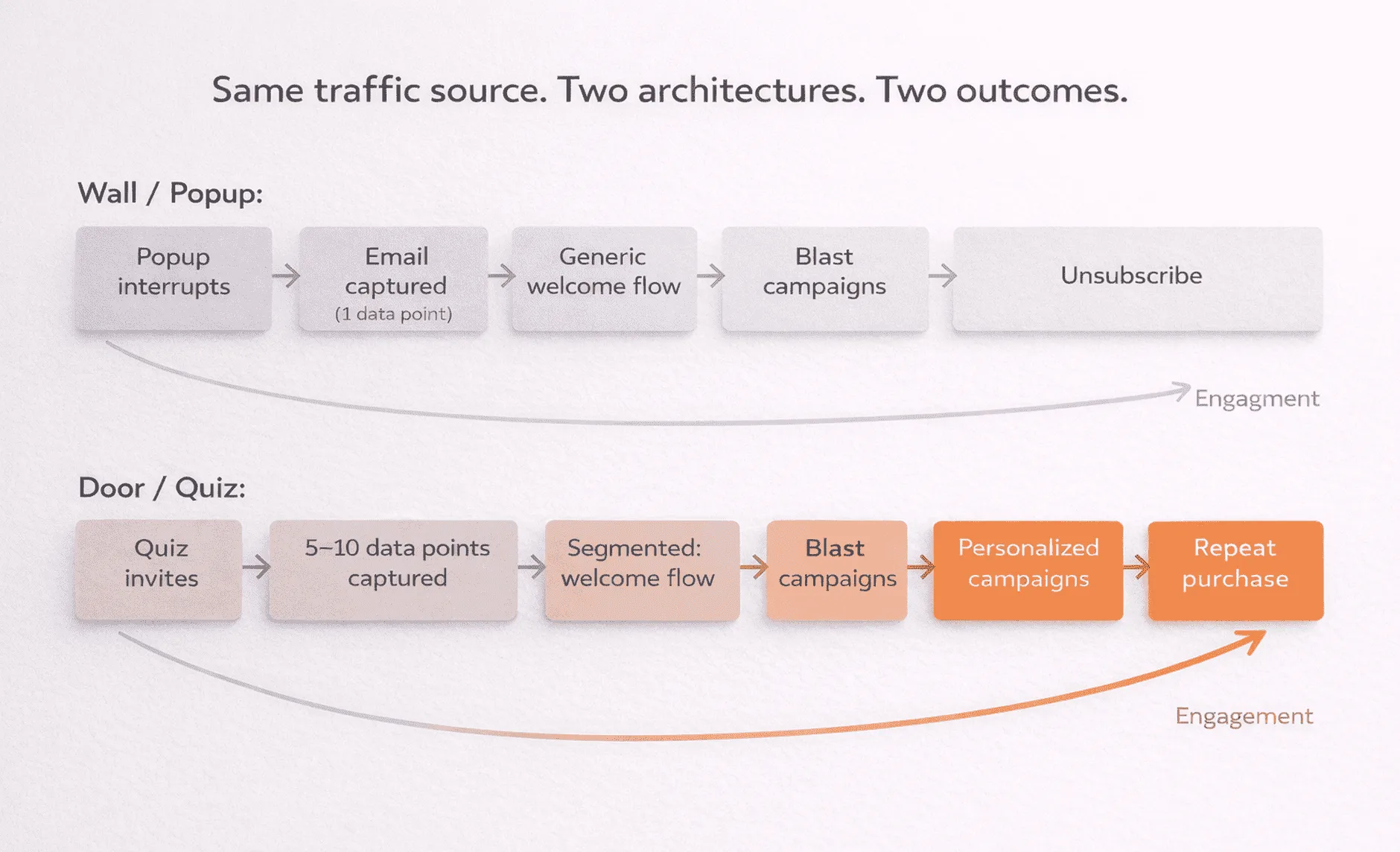
Fig. 03 Two customer-journey paths from the same first touch. The popup path declines toward unsubscribe (no relevance, no reason to stay). The quiz path builds toward repeat purchase (each email knows more than the last).
Two journeys, same traffic source. The divergence starts at capture, and compounds at every stage downstream.
The difference is structural, not cosmetic. A popup extracts value from the customer (their email) while returning only a discount that eats your margin. A quiz exchanges value: the customer shares their preferences, and the brand returns a recommendation that actually helps them make a decision. This is a transaction built on mutual benefit, not interruption.
And the downstream data difference is massive. A popup gives you one data point: an email. A quiz gives you five to ten: email, skin type, primary concern, age bracket, product preference, budget range, gifting intent. The first list is large and useless. The second list is smaller and immediately actionable: every lead enters Klaviyo with enough customer segmentation context to route them into a specific, relevant flow on day one.
The metric that matters isn’t list size. It’s list intelligence. A list of 10,000 with rich zero-party data profiles will outperform a list of 100,000 with only email addresses, every time, in every vertical, at every scale.
| Capture moment | Popup (the wall) | Quiz (the door) |
|---|---|---|
| Visitor experience | Interrupted, asked to give before given to | Opt-in, asked to engage with help on offer |
| Value exchanged | 10% off (a bribe) → email | Diagnostic recommendation → preferences + email |
| Data captured | 1 field | 5-10 fields (type, concern, age, preferences, budget, intent) |
| Selects for | Discount hunters; filters out full-price shoppers | High-intent shoppers willing to invest 90 seconds |
| Klaviyo result | Single unsegmented list → generic blasts | Per-shopper profile → conditional welcome flow on day 1 |
| Downstream | Falling open rates, rising unsubscribes, blast doom loop | 3x revenue per recipient on segmented sends (Klaviyo benchmark) |
The quiz-to-Klaviyo pipeline: how it actually works
Understanding the philosophical shift is step one. Step two is understanding the mechanics: how a product recommendation quiz replaces the popup as the primary lead capture mechanism and feeds your retention engine with actionable data. (Recommendation is just one of five quiz formats a store can ship; it’s the one most likely to lift conversion + AOV directly.)
Step 1: the invitation, not the interruption
The quiz doesn’t hijack the browsing experience. It lives as a persistent, opt-in element: embedded on the homepage hero, linked in the navigation (“Find Your Routine”), placed at the top of collection pages, or used as the destination URL for paid ad traffic instead of a generic collection page. For the paid-traffic version of this argument, see our companion piece: quiz funnels vs collection pages.
The customer chooses to engage. This self-selection is the first filter: every quiz-taker is, by definition, a higher-intent lead than a popup subscriber, because they voluntarily invested attention.
Step 2: the diagnostic
Three to five questions serve a dual purpose. For the customer, the questions build trust: “this brand wants to understand my skin, not just sell me something.” For the brand, every answer is a data point. “What’s your skin type?” becomes a Klaviyo property. “What’s your primary concern?” becomes a segment filter. “What’s your age range?” becomes a conditional split in your welcome flow.
The quiz is doing what your best sales associate does on the shop floor: asking the right questions to guide the customer toward the right product. Merchants consistently describe this mechanism as feeling “like a salesperson,” and that perception of being helped rather than sold to is exactly what drives higher engagement and downstream conversion compared to popup-captured leads.
Step 3: the value exchange
The customer receives a personalised product recommendation, not a generic coupon. They feel helped. They feel seen. The brand has just replicated the consultative experience of a physical counter interaction, at scale, 24/7, in every language.
This is the wall-to-door shift in action: instead of extracting an email with a discount, you’re exchanging value. Preference data for a tailored recommendation. Both sides win.
Step 4: the data sync
Every quiz response syncs directly to Klaviyo as customer properties, tags, or metafields. Natively. No Zapier. No CSV exports. No manual mapping. No developer ticket sitting in the backlog for three sprints.
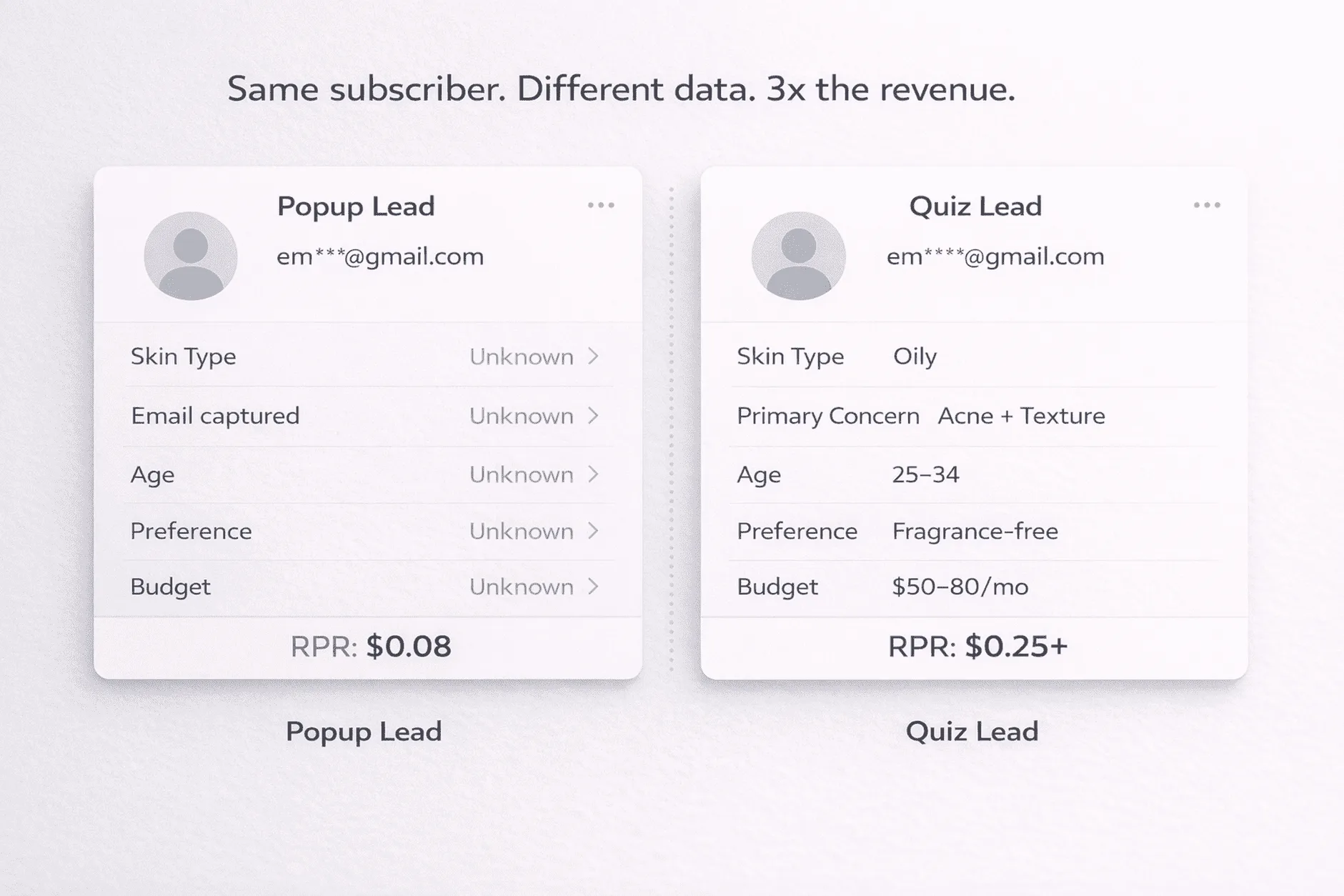
Fig. 04 Same subscriber, two Klaviyo profiles. The popup captures just an email. The quiz captures skin type, concern, age band, format preference and budget tier: five segments you couldn't build yesterday from the popup version.
The popup gives you an address. The quiz gives you a profile. Your Klaviyo flows can only be as smart as the data behind them.
The moment a quiz is completed, your Klaviyo account has a profile with enough context to route that subscriber into the right flow, immediately. This is the fundamental difference between “we have a Klaviyo integration” and “we populate your Klaviyo account with the preference data your flows actually need.”
Step 5: the activated flow
With quiz-derived properties in Klaviyo, you can build flows that were previously impossible with popup-captured leads.
An “Acne Solutions Welcome Flow” for quiz-takers who selected breakouts as their primary concern. An “Anti-Ageing Routine Sequence” for those who flagged fine lines. A “Sensitive Skin Starter Flow” for those who identified sensitivity and fragrance-free preferences. Each flow sends relevant products, relevant education, and relevant offers: not a generic “Here’s 10% off our bestsellers” blast.
Open rates climb because the subject lines match the subscriber’s actual concern. Click rates climb because the product recommendations are relevant. Revenue per recipient climbs because you’re selling solutions, not inventory. Unsubscribes drop because the emails feel curated, not spammy.
The entire pipeline (quiz logic, Klaviyo sync, flow activation) is built with the no-code drag-and-drop builder in the Built for Shopify version of RevenueHunt. You configure the conditional logic (“if answer = oily skin → recommend Product A”), connect Klaviyo with a one-click OAuth, customise the design via CSS to match your brand, and publish. No developer. No agency ticket. No waiting until next month. You’re the engineer.
The compounding effect. Segmented Klaviyo campaigns earn over 3x the revenue per recipient of generic blasts (Klaviyo segmentation benchmark). That’s revenue you unlock without growing your list by a single subscriber. The list isn’t bigger; it’s smarter.
What this looks like in practice
The before-and-after list: Skinology
For a real worked example of the popup-to-quiz shift in skincare, see the Skinology case study. The Chilean brand replaced their generic email capture with a dermatologist-designed quiz that captures skin type, concerns, lifestyle and product history before producing a personalised formulation. The follow-up flows use those answers explicitly: “Based on your dry, sensitivity-prone skin…” The list is smaller than a popup-fuelled equivalent would be, but it’s a list of qualified, segmented profiles that the brand can address directly. Around 50% of customers are repeat buyers, which the founder treats as the strongest signal that the model works once shoppers understand it.
The pattern generalises. Replace the discount-for-email popup with a skincare quiz that captures three to five data points per shopper, rebuild your Klaviyo welcome flow around the quiz tags, and revenue per recipient climbs measurably inside 60-90 days. The list is smaller (quiz completion rate is naturally lower than popup submission rate), but revenue per email sent is multiples higher.
The segment unlock
For supplements brands the unlock is often a product-market insight the popup never surfaced. A “What’s your wellness goal?” quiz captures goal, dietary restrictions, age, and activity level. The brand often discovers that one outcome (gut health, sleep, recovery) is dramatically more demanded than the email calendar reflects. This demand signal was invisible in the popup-generated, context-free list, because the popup never asked what the subscriber cared about. It just captured the address and moved on.
A dedicated “Gut Health Starter” welcome flow triggered by that specific quiz answer reshapes the entire content calendar. The quiz didn’t just capture leads; it surfaced a product-market insight that reshaped the brand’s email strategy. For the recommendation-logic options behind multi-outcome quizzes like this, see product quiz recommendation systems.
The return-reduction effect
Fashion brands use a “find your fit” quiz that captures body type, style preference, and occasion. Because customers are matched to products based on actual fit and preference data (not a generic “shop our new arrivals” experience), return rates drop measurably. The quiz stops being a marketing tool and becomes an operations tool that reduces logistics costs and improves gross margin. The CFO starts paying attention.
This is what happens when you reduce decision fatigue at the point of capture rather than trying to fix it with post-purchase flows. The best Shopify lever to reduce decision fatigue isn’t a better product page; it’s a diagnostic layer that sits before the product page and does the matching for the customer.
The lead quality pyramid: a framework for your next team meeting
Not all lead-capture methods are equal. Here’s a diagnostic framework for evaluating where your current approach sits, and what you’re leaving on the table.
| Tier | What it captures |
|---|---|
| Tier 1, email only | The standard popup model. Captures volume but zero context. Every lead enters the same generic funnel. Revenue per recipient is low and declining because you can’t segment, personalise, or target. This is where most DTC brands are stuck. |
| Tier 2, email + basic preference | A step up. Some tools now offer a single preference question alongside the email capture. Better than Tier 1, but still architecturally an interruption and limited to one or two data points. Not enough to build meaningful conditional splits in your Klaviyo flows. |
| Tier 3, email + rich zero-party profile | The quiz model. Five to ten explicit data points captured per lead, synced directly to your email platform as actionable properties. Every lead enters a specific flow based on their stated needs. Revenue per recipient is highest. List engagement is highest. Churn is lowest. The quiz doesn’t just capture the lead, it qualifies them. |
Where does your current lead capture sit on this pyramid? If you’re at Tier 1, you’re competing on volume in a market that rewards relevance. Every month you stay there, the gap between your revenue per recipient and what’s possible with segmented, preference-driven flows widens.
The popup served its purpose. The market moved on.
This isn’t anti-popup propaganda. The popup was the right tool when list size was the game, open rates were reliably above 30%, and ISPs were less aggressive about filtering. In that era, “get as many emails as possible and figure out segmentation later” was a viable strategy.
It isn’t anymore. Privacy frameworks have gutted third-party tracking. Ad platforms can’t tell you who your customers are. ISPs filter aggressively on engagement signals. Revenue per recipient matters more than list size. And “figure out segmentation later” turned into “we never figured it out because we never had the data to segment in the first place.” For the deeper version of this argument with concrete iOS ATT, ITP and ad-blocker numbers, see our first-party Shopify quiz analytics breakdown.
The brands winning now are the ones that ask their customers who they are directly and explicitly, through zero-party data collection that respects the customer’s time and delivers genuine value in return. They’re the ones whose Klaviyo accounts aren’t graveyards of anonymous addresses but living databases of stated preferences, segmented automatically, triggering flows that feel personal because they are personal.
They’re the ones who stopped building walls and started opening doors.
When the popup still has a role
This isn’t a “delete every popup” argument. Two cases where the popup still earns its keep:
- Exit intent on cold paid traffic with no quiz available yet. If a visitor is about to bounce and you have nothing else to offer, a popup that captures an email beats no capture. The lead is still mostly contextless, but it’s better than zero.
- Cart abandonment recovery. A popup that fires when a shopper tries to leave with items in the cart is a different mechanism from a wall-style entry popup. It targets known intent (the shopper has already chosen) and pairs naturally with a cart-recovery flow.
The rule is: interrupt-style popups have no place at the entry point, where they filter for discount hunters and capture zero context. Lower in the funnel, on specific moments, they can still work.
For the consent layer that has to wrap any of this, see marketing consent in your quiz.
FAQ
Should I delete my popup entirely?
No, but reposition it. Move it off the entry point (where it filters for discount hunters and captures zero context) and onto cart abandonment or exit intent for visitors who didn’t take the quiz. The quiz becomes the primary lead capture mechanism; the popup becomes a last-resort recovery tool.
What about visitors who want the 10% discount?
Offer the discount as the reward for completing the quiz, not for entering an email. That’s the same incentive structure, but now you’ve also captured five to ten preference data points alongside the email. The discount-hunter still gets their discount; you also get a segmented profile.
Won’t a smaller list hurt deliverability?
The opposite, in practice. ISPs reward engagement (opens, clicks, low spam complaints) and punish blast-style sends to unengaged subscribers. A smaller, more engaged list improves your sender reputation. A larger list of discount-hunters and disengaged subscribers degrades it. List quality has been the deliverability metric that matters for years.
What if I’m not on Klaviyo?
The mechanism generalises. The cluster covers every major ESP: HubSpot, Omnisend, Mailchimp, ActiveCampaign, and Shopify Flow for native Shopify automations. Klaviyo has the most mature integration on the RevenueHunt platform, but the architecture works on whichever platform you use.
How long until segmented quiz flows out-earn my old popup setup?
In our experience, 60-90 days. The first 30 days look slower on raw list growth because quiz completion rates are naturally lower than popup submission rates. The next 30-60 days, the segmented flows start compounding: open rates climb, click rates climb, revenue per recipient pulls ahead of the popup baseline and keeps climbing as the quiz captures more responses. By month three, the popup-driven list is usually visibly underperforming the smaller quiz-driven one.
Make the shift, or test it
Ready to replace your popup? Start with the Built for Shopify version of RevenueHunt and publish in under 15 minutes. Every quiz answer becomes a Klaviyo property. Every property becomes a segment. Every segment becomes revenue.
Want to see the data layer first? The Klaviyo zero-party data activation walkthrough shows exactly which fields land in Klaviyo and how to wire them into segmented welcome flows.
Not ready to rip out your popup stack? Run the quiz alongside your popup for 30 days. Compare revenue per recipient of quiz-captured leads vs popup-captured leads. Compare open rates, click rates, flow revenue, unsubscribe rates. Side by side, same time period, same traffic sources. The data will make the decision for you.
Next steps
- The companion piece on paid traffic specifically: quiz funnels vs collection pages.
- A real worked example of the popup-to-quiz shift in skincare: Skinology case study and Daughterela case study.
- The data activation chain inside Klaviyo: Klaviyo zero-party data.
- For ad-side audience activation: Meta Pixel quiz integration.
- Eleven funnel patterns in production: ecommerce sales funnel examples.
- Estimate the lift on your own store: quiz ROI calculator.
- The benchmark report behind every platform stat: the state of product recommendation quizzes.
Free tools & data
Put these benchmarks to work on your own store.
Free tool
Quiz ROI calculator
Estimate the extra revenue and ROI a product recommendation quiz could add to your store. Built on real data, no email required.
Calculate your ROIFree report
Ecommerce quiz benchmark report
How product recommendation quizzes really perform: conversion by category, AOV uplift, and completion, from 45M+ real quiz responses.
Read the report
Most shoppers leave because they can't find the right product