
Quiz funnels vs collection pages: why your paid traffic bounces
Your CTR is fine but CVR is tanking. Why quiz funnels outperform collection pages for paid traffic, and the post-click fix that reverses ROAS decline.
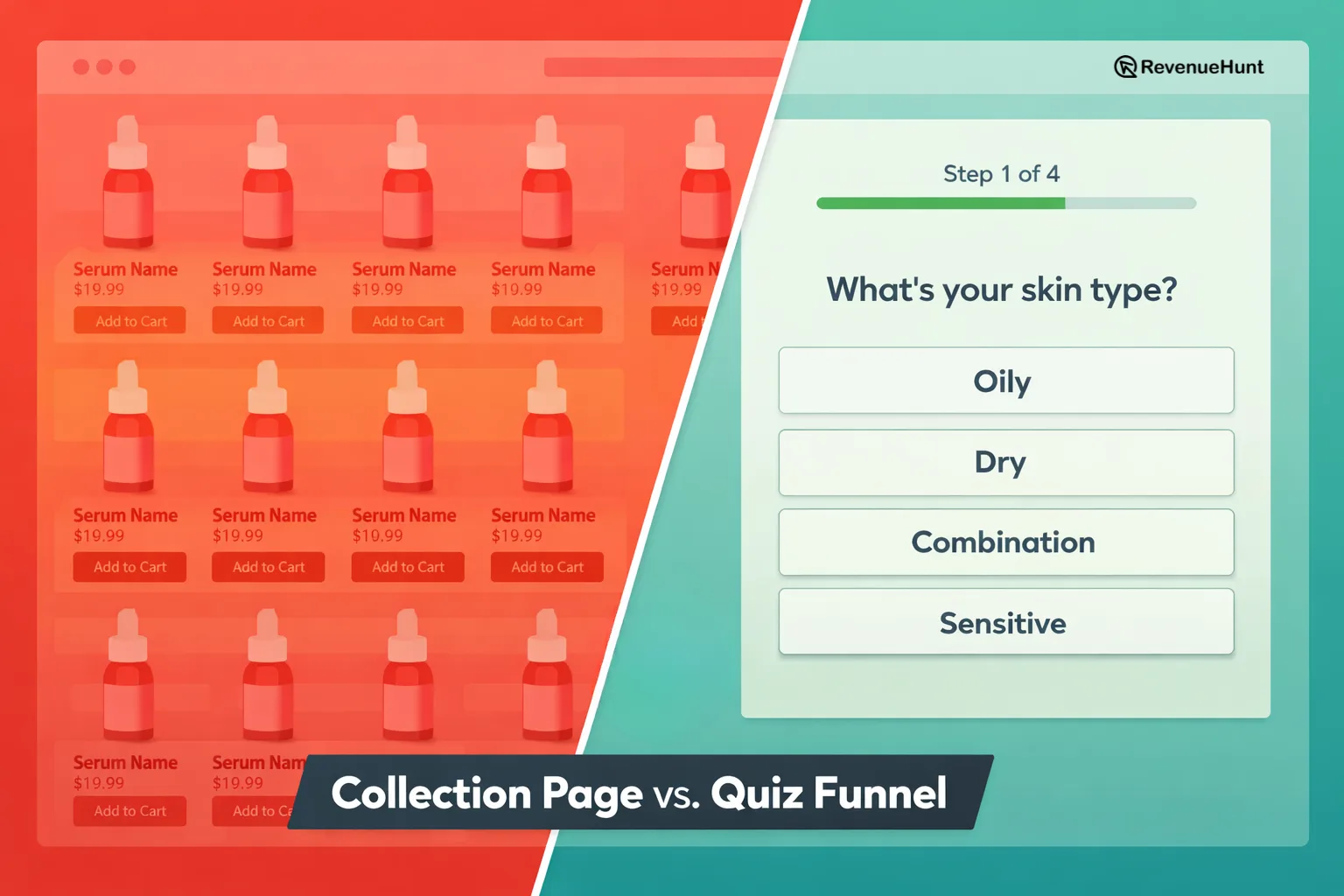
Fig. 01 Two routes from paid traffic to purchase. The collection-page route drops shoppers into a product grid and asks them to filter themselves to the right SKU. The quiz route asks 5-9 questions and serves a confident recommendation, capturing the data needed for follow-up along the way.
From endless product grids to guided recommendations.
Your CTR looks fine. Your CPMs are ugly but manageable. The creative is performing. And yet you’re staring at a 1.2% conversion rate on Shopify, watching paid traffic land on your “Shop All Serums” collection page and vanish within eight seconds. The traffic isn’t the problem. What happens after the click is the problem.
This is the structural failure hiding in plain sight inside most Shopify Plus funnels: you’re spending $10K-$30K/month acquiring traffic, then dumping it onto a page that asks the customer to do the work of a trained salesperson. Browse 30 serums. Compare ingredients. Self-diagnose a skin type. Pick one. Most won’t. They’ll bounce, your pixel won’t learn, and tomorrow’s CPM will be higher than today’s.
The fix isn’t a prettier collection page. It’s a fundamentally different post-click architecture: one that guides instead of displays, captures data instead of email addresses, and feeds signal back to your ad platform instead of starving it.
It’s a quiz funnel. And the performance gap between quiz funnels and collection pages isn’t marginal; it’s structural.
What you'll learn
- →Why the collection page was never designed for paid traffic, and how decision fatigue kills CVR.
- →The signal-loss spiral: how low CVR degrades pixel targeting and compounds CPM inflation week over week.
- →Why landing-page builders, popup tools, and over-engineered enterprise stacks don't fix the root cause.
- →The three mechanisms a quiz funnel uses: guidance, zero-party data capture, and signal reinforcement.
- →A real worked example: how a US anti-ageing device brand hit 9.8% quiz-to-purchase conversion on cold Meta traffic.
The quiz-funnel performance gap
5.5%
of shoppers who finish a quiz place an order, about 1 in 18, 2.75x a typical 2% store baseline (RevenueHunt benchmark, 45M+ responses)
+11-15%
within-store AOV uplift on quiz-attributed orders versus non-quiz orders, holding in roughly 7 in 10 stores
1 in 5
quiz-attributed orders land more than 30 days later, which means the segmentation layer keeps converting through email and ads for months
The collection page was never built for paid traffic
Collection pages were designed for organic browsing: a customer who already knows your brand, has time to explore, and is comfortable self-selecting. They’re optimised for SEO crawling and catalogue discovery. That’s fine for direct traffic and branded search.
But paid traffic is a different animal. You’re buying attention from someone who saw a 15-second creative, felt a spark of interest, and clicked. They arrive with intent but zero context. They don’t know your product line. They don’t know what’s right for them. And you’re greeting them with a wall of 30+ options.
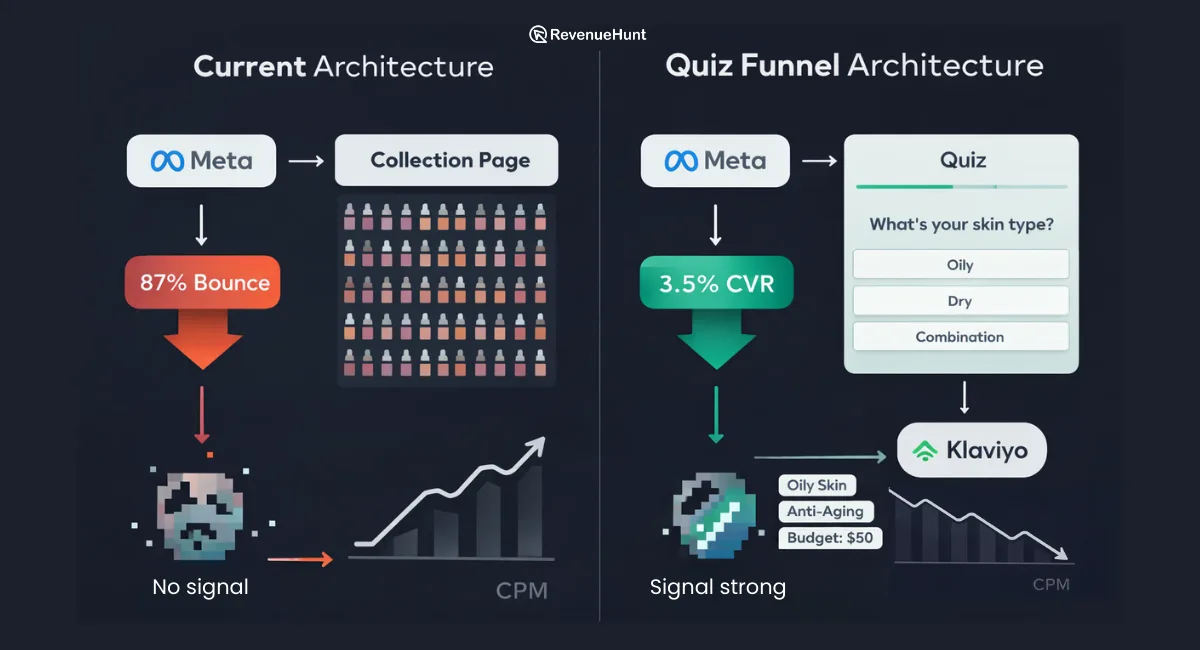
Fig. 02 The current ecommerce architecture treats every visitor as anonymous traffic until checkout. A quiz funnel converts anonymous traffic into actionable customer data at first touch, regardless of whether the visitor buys today.
Turn anonymous traffic into actionable customer data.
The paradox of choice is killing your CVR
When a customer lands on a collection page with 30 serums, 40 supplements, or 25 shades, cognitive overload kicks in. They don’t choose wrong. They don’t choose at all. The paradox of choice is well-documented in behavioural economics, but its impact on ecommerce conversion is visceral and measurable.
A shopper who came to find “something for my dry skin” is now scrolling past retinol, niacinamide, vitamin C, hyaluronic acid, peptides, with no mechanism to filter by her actual need. Every additional product on the page increases cognitive load. You’re essentially asking the visitor to self-diagnose, self-match, and self-select. That’s the job of a salesperson. Most customers won’t do it. They’ll bounce.
The signal-loss spiral: a compounding crisis
Here’s where it gets worse. Post-iOS14, your ad platform has less data to work with. When traffic bounces without converting, the pixel doesn’t register a purchase event. Without purchase events, Meta’s algorithm can’t optimise targeting. Targeting degrades. CPMs rise. ROAS declines. So you increase spend to compensate, sending more traffic into the same broken funnel.
This isn’t a one-time problem. It’s a death spiral that compounds weekly. Every unconverted visit trains the algorithm in the wrong direction, and your next campaign launches from a weaker position than the last.
The signal-loss spiral: Low CVR → fewer pixel events → degraded targeting → rising CPMs → lower ROAS → more spend needed → more traffic into the same broken funnel → repeat. The collection page isn’t just failing to convert; it’s actively degrading your ad performance over time. For the full mechanics of how Pixel attribution breaks under iOS 14+, ITP and ad blockers, see our first-party Shopify quiz analytics breakdown.
The decision-fatigue tax
Every additional product displayed extracts a cognitive toll: a “decision-fatigue tax” that accumulates with each scroll. By the time a visitor has scanned 15 products without finding a clear match, they’ve spent their decision-making energy. The default response is inaction: close the tab, move on, forget the brand.
This isn’t a failure of your traffic quality or your creative strategy. It’s an architectural failure inherited from how ecommerce was built: catalogue-first, browse-oriented, optimised for product discovery rather than conversion rate optimisation. Paid traffic doesn’t browse. It needs to be guided.
Why the current “fixes” don’t actually fix anything
If you’ve felt this pain, you’ve probably tried the obvious solutions. None of them address the root cause.
Landing-page builders make prettier dead ends
Tools like Shogun, GemPages, and PageFly let you build visually polished pages. But a beautiful page that still displays 30 products still causes decision fatigue. You’ve upgraded the wallpaper in a house with a broken foundation. The customer still has to self-select from too many options, and no amount of design polish changes that.
Generic popup tools add noise, not signal
Standard popup tools capture email addresses in exchange for a discount. But the lead that enters your list from a “Spin to Win” wheel or a “10% Off” popup comes with zero context. You don’t know if they have oily skin or dry skin, if they’re 25 or 55, if they’re shopping for themselves or a gift. As one merchant put it in an app review: “I have a list but no logic.”
That lead goes into a single unsegmented list, and your only option is a generic blast email. Open rates drop. Unsubscribes climb. Revenue per recipient flatlines. You’re drowning in volume but starving for insight. For the broader argument on why popups are the wrong tool here, see why popups are walls and quizzes are doors.
Over-engineered enterprise tools create developer dependency
On the other end of the spectrum, complex enterprise solutions promise deep personalisation but require developer implementation, create theme conflicts, and demand a learning curve that kills your launch velocity. Merchants report spending weeks configuring logic builders that “require a PhD to understand,” or discovering they need Zapier to connect their quiz data to Klaviyo. If your marketing team can’t launch and iterate without filing a dev ticket, you’ve traded one bottleneck for another.
The core failure is architectural
None of these tools create a guided path from uncertainty to purchase. They all assume the customer knows what they want. In verticals like skincare, supplements, wellness, and beauty, they don’t. The customer needs a consultative experience, not a catalogue.
The quiz funnel: a different post-click architecture
A quiz funnel replaces the collection page as your ad destination. Instead of “browse 30 serums,” the customer answers 3-5 diagnostic questions: What’s your skin type? What’s your primary concern? What’s your budget?
This isn’t a gimmick. It’s a structural redesign of the post-click experience that solves three problems simultaneously. (For the category overview, including the five formats a store can ship and how they compare, see the umbrella guide; the rest of this piece focuses on the recommendation-quiz variant used as a paid-traffic landing page.)
Mechanism 1: guided selling eliminates decision fatigue
The quiz functions as a digital salesperson. Through conditional logic, logic jumps that route customers down different paths based on their answers, it narrows the entire catalogue to 1-3 matched product recommendations. The customer doesn’t choose from 30 options. They receive a personalised result that feels curated for them.
Merchants who’ve adopted this approach consistently describe it the same way: “It’s like having a salesperson on the site 24/7.” That metaphor isn’t accidental. It captures the fundamental shift, from passive catalogue display to active consultative selling.
The decision tree of which logic to use (voting, fixed, slots, scoring) is covered in product quiz recommendation systems. A no-code drag-and-drop builder in the Built for Shopify version of RevenueHunt means you can customise the logic, design, and product mappings yourself, and launch in under 15 minutes without waiting on a developer or agency.
Mechanism 2: zero-party data capture turns bounces into intelligence
Here’s where the quiz funnel diverges most sharply from every other post-click solution: even when the customer doesn’t buy immediately, you’ve captured something far more valuable than an email address.
Every quiz response, skin type, primary concern, age range, product preference, is captured as zero-party data. This is information the customer intentionally and proactively shares with your brand. And with a native Klaviyo integration, those responses sync directly as customer tags and properties. No Zapier. No CSV exports. No middleware.
This transforms your Klaviyo account from a list of anonymous email addresses into a segmented database of rich customer segmentation profiles. You can now trigger a “Your Perfect Routine” flow for someone who told you they have dry skin and are concerned about fine lines, not a generic welcome series that treats every subscriber identically.
The data shift. A standard popup captures who visited. A quiz captures what they need. That distinction is the difference between a Klaviyo account that’s a graveyard and one that’s a revenue engine: segmented Klaviyo campaigns earn over 3x the revenue per recipient of generic sends (Klaviyo segmentation benchmark).
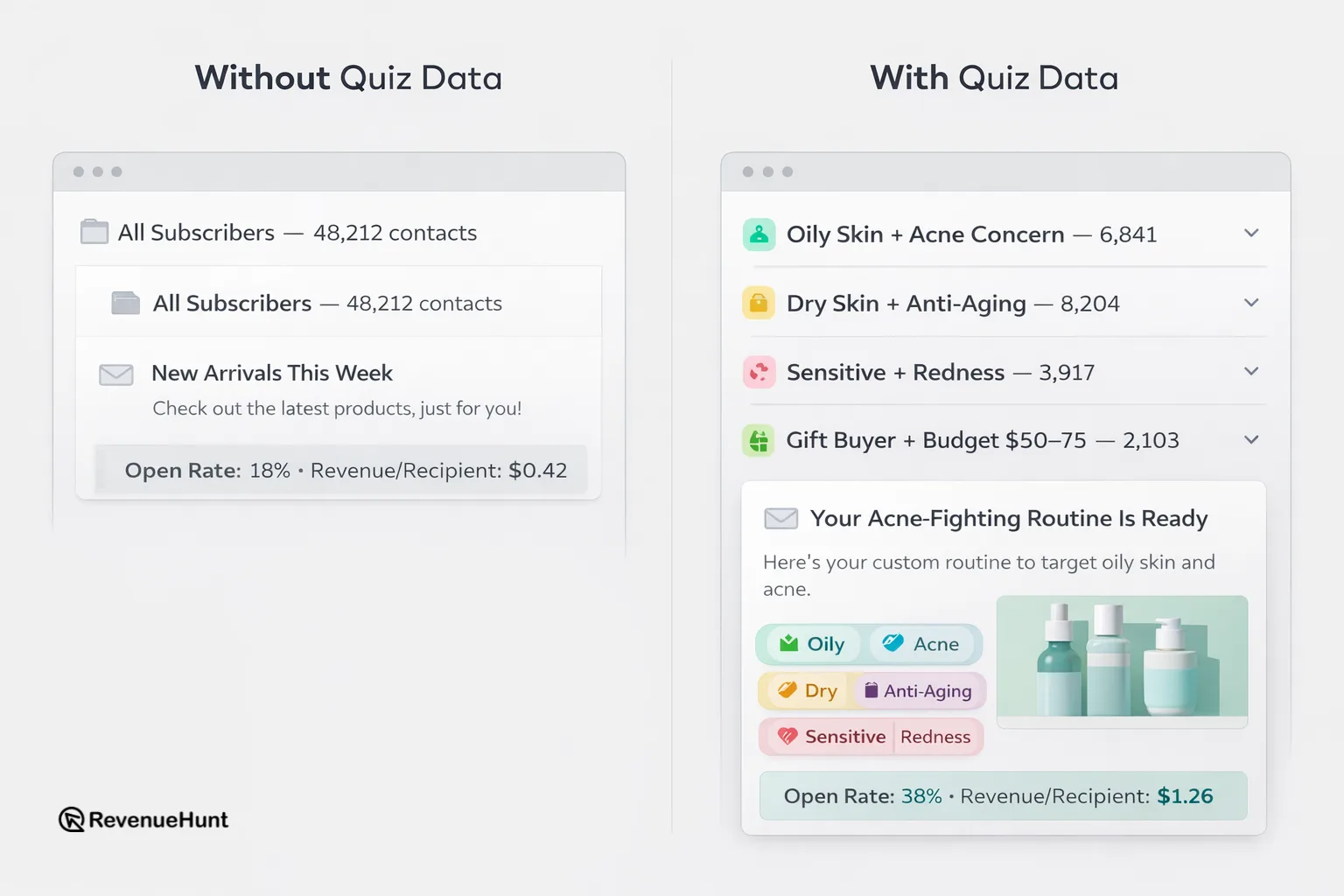
Fig. 03 Without quiz data: every email is generic, every campaign reads the same. With quiz data: each campaign reads the customer's actual preferences. Same platform, same send volume, dramatically different revenue per recipient.
Generic email blasts vs personalised campaigns powered by quiz data.
Mechanism 3: the signal reinforcement loop
This is the strategic payoff that most merchants miss. Higher conversion rates from quiz funnels feed more purchase events back to Meta’s pixel. More purchase events improve algorithmic targeting. Better targeting lowers CPMs. Lower CPMs improve ROAS. And that improved ROAS funds more traffic into a funnel that actually converts. For the audience-building side of this loop (retargeting quiz takers, lookalike audiences seeded from quiz completers), see Meta Pixel quiz integration.
The quiz funnel doesn’t just fix your conversion rate. It reverses the signal-loss death spiral and replaces it with a virtuous cycle.
The post-click conversion stack: a framework
Here’s the mental model that ties this together. Think of your post-click experience as a three-layer stack, where each layer solves a specific structural problem in the modern paid acquisition funnel:
| Layer | Mechanism | Solves / replaces |
|---|---|---|
| Layer 3: Signal Reinforcement | Higher CVR → more pixel events → better targeting → lower CPMs → improved ROAS | Solves: The signal-loss death spiral |
| Layer 2: Data Capture | Quiz responses sync to Klaviyo as customer tags → segmented flows → personalised lifecycle | Solves: The “dumb list” problem |
| Layer 1: Guidance | Quiz replaces collection page as ad destination → 3-5 diagnostic questions → matched recommendation | Solves: Decision fatigue and paradox of choice. Replaces: Ad → Collection Page → Hope |
This is the modern alternative to the “Ad → Collection Page → Hope” funnel architecture. Each layer compounds the value of the layer below it: guidance drives conversion, conversion drives data, data drives signal quality, and signal quality drives acquisition efficiency.
What this looks like in practice
A US anti-ageing device brand: 9.8% quiz CVR, $691K in 90 days
This is the cleanest worked example in the cluster: a real US anti-ageing device brand replaced their collection-page ad destination with a 12-step qualifying quiz funnel. Cold Meta traffic now lands directly on the quiz, not on a “shop all” page. The numbers are real and disclosed:
- 9.8% quiz-to-purchase conversion on cold Meta traffic (against a baseline of ~2% on the previous collection-page funnel)
- 42.64% AOV lift vs the brand’s non-quiz orders
- $691,128 in 90 days of attributable revenue
- The qualifying questions also screen out tyre-kickers, so the customers who reach the results page are highly self-selected and the bundle-add rate is higher than a typical browser
Full breakdown of the funnel architecture, the persuasion checkpoint strategy and the AOV lift mechanic: anti-ageing beauty brand case study.
A supplement brand that turned email into a revenue channel
A supplement brand built a “What’s Your Wellness Goal?” quiz that captured goal, dietary restrictions, age, and activity level. Every response synced to Klaviyo as customer properties: no Zapier, no manual exports, no data gaps.
The brand built a “Your Custom Stack” email flow triggered by quiz completion. Because each email referenced the customer’s specific goals and restrictions, segmented revenue per recipient ran in line with the Klaviyo benchmark of 3x generic sends. The quiz didn’t just convert traffic on-site; it created an automated backend revenue engine powered by data that would have been invisible without it. See Skinology case study for a similar pattern executed in skincare.
The compounding advantage: why this gets better over time
The collection page is a static asset. It doesn’t learn. It doesn’t improve. It converts at roughly the same rate whether it’s your 100th visitor or your 100,000th. It’s a fixed cost that delivers diminishing returns as your traffic scales and decision fatigue compounds.
A quiz funnel compounds. Every completed quiz adds another data point to your Klaviyo segments, making your email flows more precise and your average order value higher. Every purchase feeds the pixel, improving your ad targeting and lowering your CPMs. Every segmented email flow generates revenue that funds more acquisition. And because the quiz runs autonomously (merchants describe it as “set and forget” once the logic is built), it operates as always-on infrastructure rather than a campaign that requires daily management.
This is what separates a “conversion tool” from “data infrastructure.” The quiz isn’t just converting today’s traffic. It’s building an asset, a growing database of customer intelligence, that makes every future dollar of ad spend more efficient than the last.
For brands expanding internationally, this infrastructure scales with you. Quiz localisation, displaying the correct currency, language, and region-specific product availability through Shopify Markets integration, means the post-click experience feels native in every market. A German customer sees the quiz in German with prices in euros and only products available in their region. That level of localisation builds trust instantly, and the absence of it destroys it just as fast. For brands operating under GDPR or CCPA, see our marketing consent inside the quiz guide for built-in consent flows that handle compliance without bolting on additional tools or legal review. Transparent data collection isn’t a feature add-on; it’s table stakes for any brand selling in the EU.
The strategic takeaway
If your paid traffic is bouncing, the instinct is to blame the creative, adjust the audience, or increase the budget. But if your CTR is healthy and your CVR is flat, the problem isn’t above the click; it’s below it. The post-click experience is where the funnel leaks, where the data goes dark, and where the pixel starves.
The quiz funnel is not a “nice to have” conversion optimisation tactic. It’s the structural fix for the three compounding crises facing every brand running paid acquisition in a privacy-first environment: decision fatigue that kills conversion, data blindness that kills retention, and signal loss that kills ad efficiency.
The brands that win in this environment won’t be the ones spending the most on traffic. They’ll be the ones extracting the most value from every click, guiding the customer, capturing the data, and feeding the signal loop. The Post-Click Conversion Stack isn’t a theory. It’s the operating model for consultative commerce, and the quiz is the engine at its core.
FAQ
When does a quiz funnel beat a collection page on Shopify?
Whenever the inbound traffic is cold or low-context: paid social, paid search on broad keywords, influencer campaigns, lookalike audiences. The quiz wins because the visitor has high intent but no product knowledge. Branded organic search and direct traffic from email already carry context, so collection pages convert reasonably well there. The bigger your paid mix, the bigger the quiz funnel’s lift.
What about high-intent branded search traffic?
Branded search shoppers usually have intent and context, so the collection page is fine. Don’t redirect that traffic. The quiz funnel is specifically the right fix for cold paid acquisition where the click-through carries intent but the visitor doesn’t yet know your product line.
How long until ROAS recovers after switching ad destinations?
Pixel re-learning usually takes 7-14 days. The first week tends to look worse before it looks better (the algorithm adjusts to the new conversion event pattern), then targeting tightens and CPMs start dropping. By week 3-4, you should see ROAS improvements above the pre-switch baseline. Stick with it for at least 28 days before judging.
Can a quiz funnel work on a small catalogue (50-200 SKUs)?
Yes. The quiz doesn’t depend on catalogue size; it depends on the number of distinct shopper jobs your store serves. A 150-SKU skincare store with three distinct jobs (acne, anti-ageing, sensitive skin) is a great quiz candidate. A 150-SKU stationery store where everyone wants “a nice notebook” probably isn’t.
Does this work for brands not on Shopify?
The mechanism does, but the specific integration depths and revenue tracking vary. The Built for Shopify version of RevenueHunt ships native Shopify Markets and automatic Shopify Orders attribution. WooCommerce, Magento, BigCommerce and Standalone versions have the same quiz logic and the same Klaviyo integration, but native revenue attribution depends on GA4 instead of Shopify Orders.
Next steps
- The real worked example with disclosed numbers: anti-ageing beauty brand case study.
- The argument on popups specifically: why popups are walls and quizzes are doors.
- The data layer behind the segmented Klaviyo flows: Klaviyo zero-party data activation and customer tags in product quizzes.
- The ad-audiences side of the signal loop: Meta Pixel quiz integration.
- The recommendation logic options: product quiz recommendation systems.
- Eleven funnel patterns in production: ecommerce sales funnel examples.
- Estimate the revenue lift on your own store: quiz ROI calculator.
- The benchmark report behind every stat in this article: the state of product recommendation quizzes.
Free tools & data
Put these benchmarks to work on your own store.
Free tool
Quiz ROI calculator
Estimate the extra revenue and ROI a product recommendation quiz could add to your store. Built on real data, no email required.
Calculate your ROIFree report
Ecommerce quiz benchmark report
How product recommendation quizzes really perform: conversion by category, AOV uplift, and completion, from 45M+ real quiz responses.
Read the report
Most shoppers leave because they can't find the right product