
Skincare quiz guide for Shopify and WooCommerce (2026)
Skincare quiz guide for Shopify and WooCommerce: 6 quiz types, build steps, Klaviyo integration, data-backed conversion rules from 20,000+ stores.
A skincare quiz is the highest-leverage funnel mechanic for beauty brands: it converts hesitant browsers into confident buyers by playing the role of an in-store beauty advisor, collects zero-party data that powers segmented email and ad flows, and consistently lifts conversion rates from category-page averages of 2-3% to quiz-driven averages of 10-25%. This guide covers the six skincare quiz types that work, how to build them on Shopify and WooCommerce, and the data-backed rules that separate top performers from quizzes that never get used. For the broader data category, see our zero-party data guide; for a real skincare brand running this playbook, see the Skinology case study.
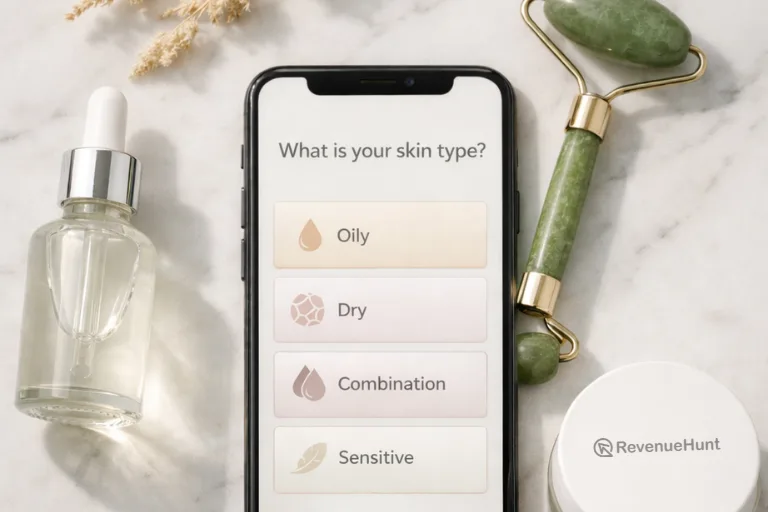
Fig. 01 An in-store beauty advisor does in person what a product recommendation quiz does online: ask the right questions, then hand over a routine the shopper actually trusts.
Your customers cannot pick from 40 foundation shades alone
Walk into any Sephora and a beauty advisor appears within seconds. They ask about your skin type, your concerns, your budget. Within minutes, you leave with a curated routine you actually trust. That experience is why physical beauty retail still converts at 20-30%.
Your online store converts at 2-3%. The gap is not your products. It is the absence of guidance.
A beauty catalog is inherently complex. A skincare brand with 30 serums differentiates them by skin type, active ingredients, concern, and price. A cosmetics brand with 40+ foundation shades cannot expect a first-time visitor to self-select with confidence. When shoppers cannot decide, they do one of two things: they bounce, or they buy the wrong product and return it. Both outcomes cost you money.
The product recommendation quiz is the digital equivalent of that beauty advisor. It asks the right questions, filters your catalog intelligently, and delivers a confident, personalized recommendation in under 60 seconds. But calling it a “fun interactive tool” undersells what it actually is: critical revenue infrastructure for beauty and skincare brands on both Shopify and WooCommerce.
| What the quiz does | Business outcome |
|---|---|
| Guides hesitant browsers to confident purchases | Conversion rate lift |
| Captures skin type, concerns, and ingredient preferences | Zero-party data asset you own permanently |
| Feeds your email platform with deep segmentation data | Personalized retention flows and higher LTV |
| Matches the right product to the right customer first time | Reduced return rates, protected margin |
The numbers behind this guide: RevenueHunt’s platform spans 20,000+ stores, 45M+ quiz responses, and $370M+ in merchant revenue (2026 benchmark report). Across the platform, 5.5% of shoppers who finish a quiz place an order (about 1 in 18, roughly 2.75x a typical 2% store), and within-store AOV in the beauty/skincare vertical runs +20% on quiz orders versus non-quiz orders (holds in 80% of stores). Every recommendation below comes from that real-world dataset.
Skincare quiz benchmarks (real platform data)
The platform numbers above are cross-category. Narrowed to the 280 skincare quizzes on the RevenueHunt platform over the trailing 180 days, the category over-indexes on both conversion and order value:
| Metric (skincare quizzes) | Median | Top 25% | Top 10% |
|---|---|---|---|
| Completion rate | 88% | 99% | 100% |
| Conversion (quiz to order) | 8% | 17% | 28% |
| Revenue per completion | $6.88 | $17 | $29 |
| Average order value | $84 | $131 | $191 |
The median skincare quiz converts at 8%, against the 5.5% cross-category pooled figure, and the top quartile clears 17%. Structurally, the median skincare quiz runs 6 questions with about 4 answer choices each and recommends 5 products; 80% recommend a bundle or routine rather than a single SKU, and 80% of skincare quiz traffic is mobile. Revenue figures use RevenueHunt’s own order attribution and include stores with no attributed orders yet, so the medians are conservative.
Whether your store runs on Shopify or WooCommerce, this guide covers everything: which quiz types to build, how to build them with proven data-backed best practices, how to connect quiz data to your email platform, and how to turn quiz completions into the foundation of your retention strategy.
Six quiz types that work for beauty and skincare brands
Not all beauty quizzes serve the same purpose. The quiz type you build should match the specific business outcome you are trying to drive. Here is a taxonomy of the six quiz types that consistently perform for beauty brands.
Skin type finder
This is the minimum viable quiz for any skincare brand. “Is your skin oily, dry, combination, sensitive, or normal?” is the foundational question that unlocks every downstream personalization decision. A shopper who declares their skin type is no longer an anonymous visitor - they are a segmented customer profile.
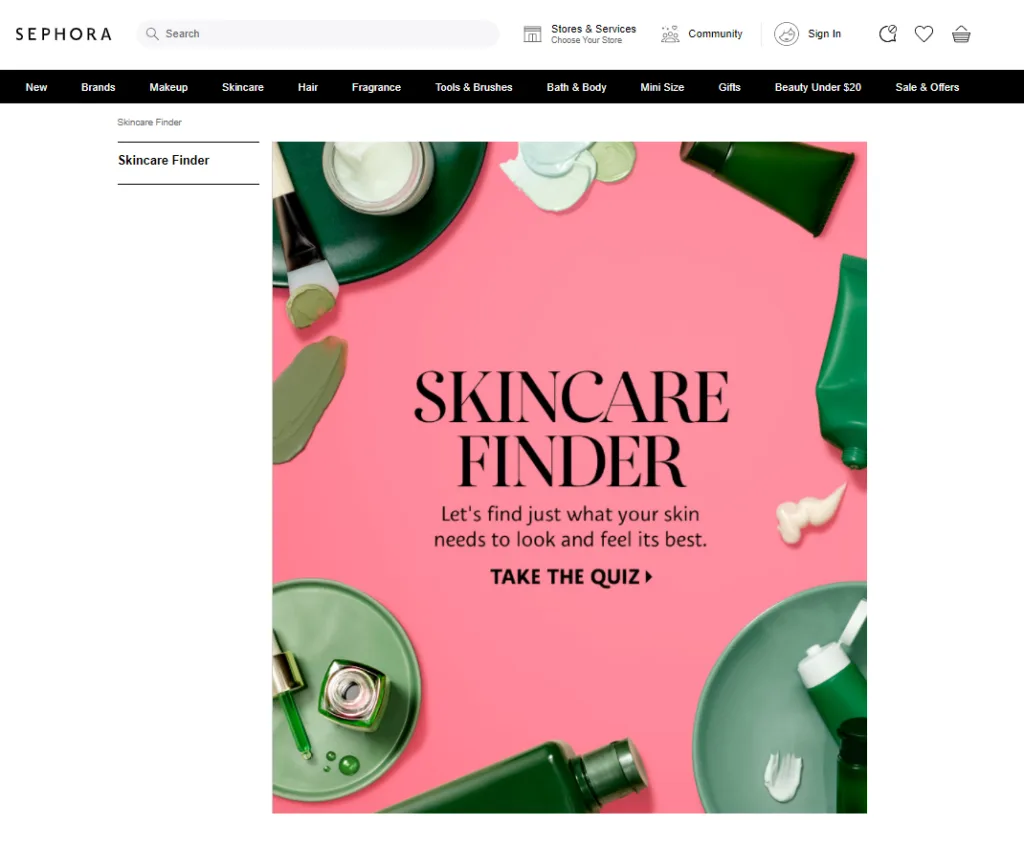
Fig. 02 A skin type finder in the wild (Sephora, 2021). The foundational "is your skin oily, dry, combination, sensitive, or normal?" question turns an anonymous visitor into a segmented profile.
| Data captured | Skin type as a Klaviyo custom property |
| Flows enabled | "Your Personalized Skincare Routine" welcome series segmented by skin type; replenishment emails filtered by formulation type |
| Primary outcome | Conversion rate lift. Build this first on both Shopify and WooCommerce before any other quiz type. |
Routine builder
A multi-step quiz that recommends a complete routine - cleanser, toner, serum, moisturizer, SPF - using recommendation slots to assign one product per step. This is the highest-AOV quiz type in the beauty vertical because it recommends a bundle, not a single SKU, which is why 80% of skincare quizzes on the platform recommend a routine rather than one product.
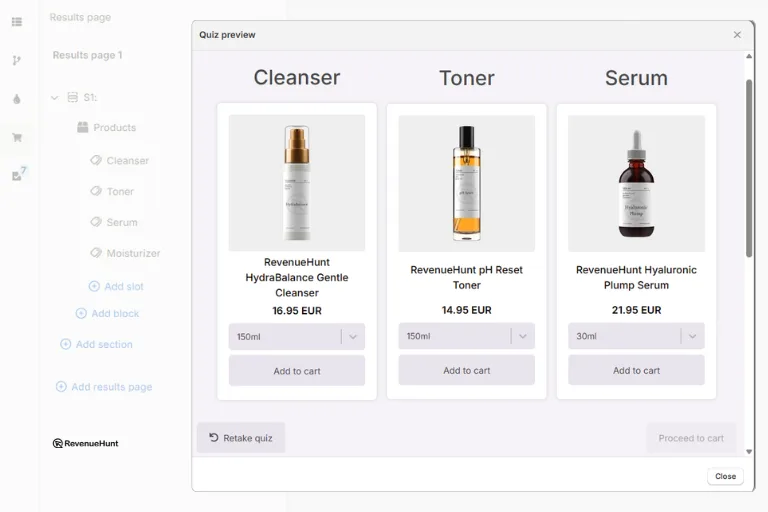
Fig. 03 RevenueHunt's Routine Builder template recommends a complete cleanser-to-SPF routine using recommendation slots, one product per step. The highest-AOV quiz type in beauty.
| Data captured | Full preference profile: skin type, primary concern, texture preferences, budget range |
| Flows enabled | "Complete Your Routine" abandoned cart series; "Refill Your Cleanser" replenishment flows timed to average product lifespan |
| Primary outcome | Average order value increase. Particularly powerful for skincare brands with a hero SKU ecosystem. |
Shade matcher / foundation finder
Critical for cosmetics brands selling foundation, concealer, or tinted SPF. Picture questions showing skin tone swatches allow customers to self-identify their shade range, and conditional logic filters the catalog to matching shades.
| Data captured | Skin tone range and undertone as Klaviyo properties |
| Flows enabled | "Your Shade Is Back in Stock" restock alerts; new collection launch emails targeted to matching shade families |
| Primary outcome | Return rate reduction. Wrong shade is one of the top reasons for cosmetics returns, and a well-built shade finder directly eliminates that problem. |
Ingredient sensitivity screener
“Do you have any ingredient sensitivities or allergies?” This quiz type builds enormous trust with the health-conscious beauty consumer and the clean beauty shopper. It uses product exclusion logic to filter out items containing flagged ingredients from the recommendation results entirely.
| Data captured | Ingredient flags as negative Klaviyo properties (exclude from retinol campaigns, exclude from fragrance upsells) |
| Flows enabled | "Fragrance-Free Favorites" curated product emails; "Clean Routine" series for sensitivities-flagged subscribers |
| Primary outcome | Trust and brand loyalty, particularly in the clean beauty and sensitive skin segments. |
Gift guide / gift finder
Seasonal for Q4 and evergreen for Mother’s Day, Valentine’s Day, and birthdays. “Who are you shopping for?” “What is their skin type?” “What is your budget?” solves the acute problem of the gift buyer who has zero product knowledge and will abandon without help.
| Data captured | Gift-vs-self-purchase flag, budget range, recipient skin profile |
| Flows enabled | Post-purchase "Did they love it? Here is what to try next" sequence |
| Primary outcome | Q4 conversion rate recovery for non-beauty shoppers arriving via gifting intent. |
Concern-based matcher
“What is your number one skin concern?” routes the shopper to the product subcategory that addresses their specific issue: acne, fine lines, hyperpigmentation, redness, or dullness. Particularly effective for brands with a large SKU count across multiple concern categories.
| Data captured | Primary skin concern as a Klaviyo property |
| Flows enabled | Concern-specific educational drip series ("Your Anti-Aging Protocol," "Clearing Acne: Week by Week"); upsell sequences targeted to the same concern category |
| Primary outcome | Email engagement and repeat purchase rate from deeply segmented concern-based flows. |
All six quiz types are available as pre-built templates in the RevenueHunt no-code builder, on both Shopify and WooCommerce. You do not need a developer to build any of them.
How to build a high-converting beauty quiz: data-backed best practices
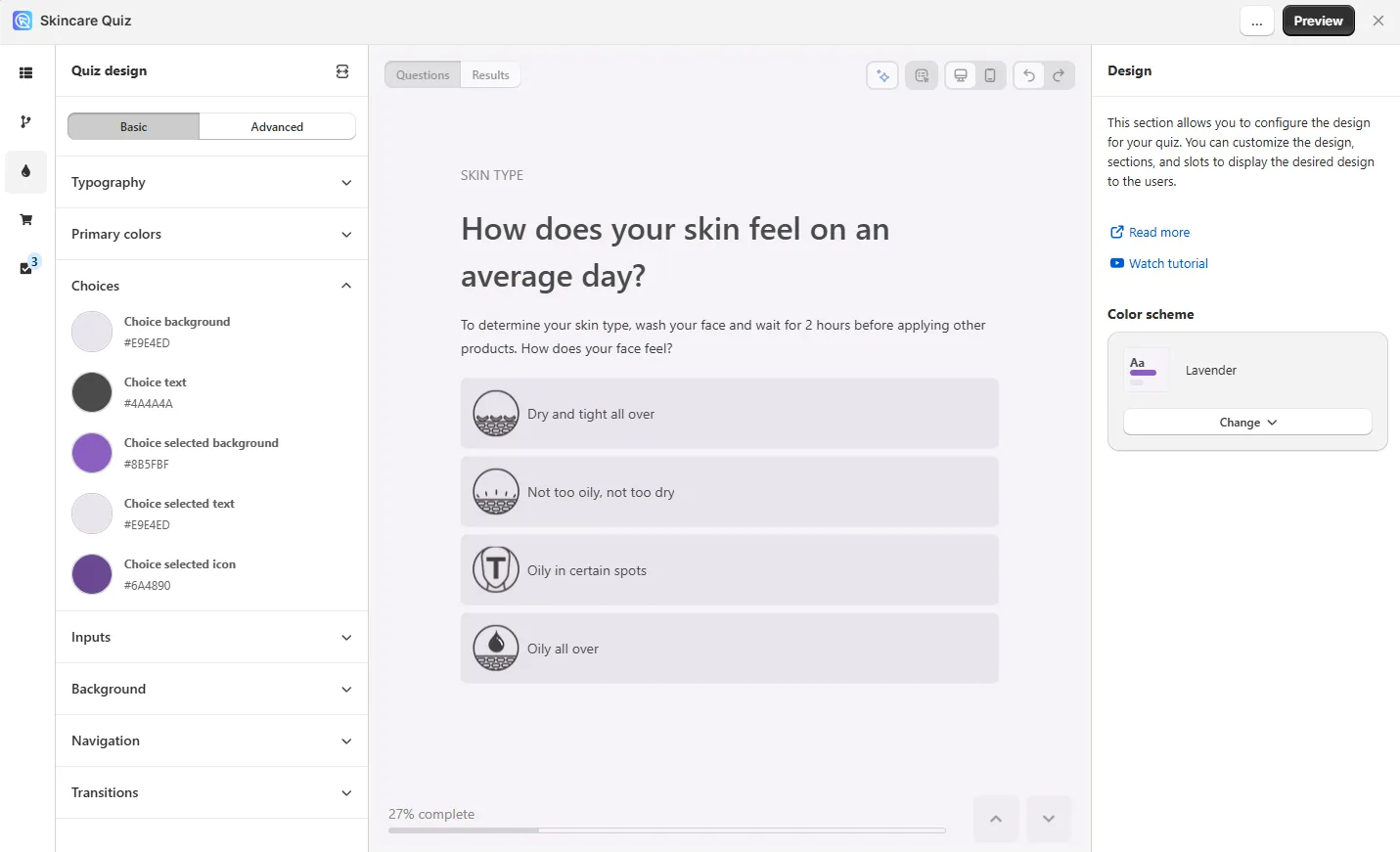
Fig. 04 The question types in the RevenueHunt no-code builder. The same palette assembles any of the six beauty quiz types without a developer.
The following best practices are drawn from the RevenueHunt dataset of 20,000+ stores and 45M+ responses. They are not opinions about what should work. They are patterns from what actually does.
What the top skincare quizzes share. Among the top third of skincare quizzes by revenue per completion, the build is strikingly consistent: 6 questions, about 4 answer choices each, a bundle/routine recommendation of roughly 5 products, email gated before the results, and branching logic on about half. Treat that as your default starter spec and deviate only with a reason.
Choose the right quiz length
The old advice to “keep it short” is wrong for beauty. The platform data tells a more nuanced story:
| Number of questions | Average conversion rate | Note |
|---|---|---|
| 1-5 questions | 9.8% | Feels superficial for skincare |
| 6-8 questions | 10.4% | Sweet spot for most beauty quizzes |
| 9-12 questions | 11.0% | Routine builders and shade finders |
Longer quizzes outperform shorter ones because beauty shoppers expect a thorough assessment. A 3-question quiz feels superficial for something as personal as skincare. The sweet spot for most beauty quizzes is 7-8 questions: thorough enough to feel expert, short enough to complete on mobile in under two minutes. In skincare specifically, the median quiz runs 6 questions and the top revenue performers cluster right at 6, so 6 to 8 is the band to aim for.
Start linear, not branched
This is the insight that surprises most beauty brand builders: the majority of top-converting quizzes are completely linear. Every shopper sees the same questions, and the recommendation engine handles the product matching behind the scenes.
Branching is useful in one specific scenario: a multi-category brand where an early question (hair care vs. skin care vs. body care) splits shoppers into genuinely distinct product universes. Outside of that, beauty brands consistently over-engineer branching logic, which creates maintenance complexity without measurable conversion gains.
Start linear. Get the product mapping right. Then add conditional logic only where it genuinely eliminates irrelevant questions - such as skipping ingredient sensitivity questions for shoppers who flagged “no sensitivities.”
Use images where they genuinely help
Images are not required for high conversion. Relevance drives conversion. But in the beauty vertical, images serve a unique functional purpose that text cannot replicate: visual identification.
| Use picture questions for | Use text-only questions for |
|---|---|
|
|
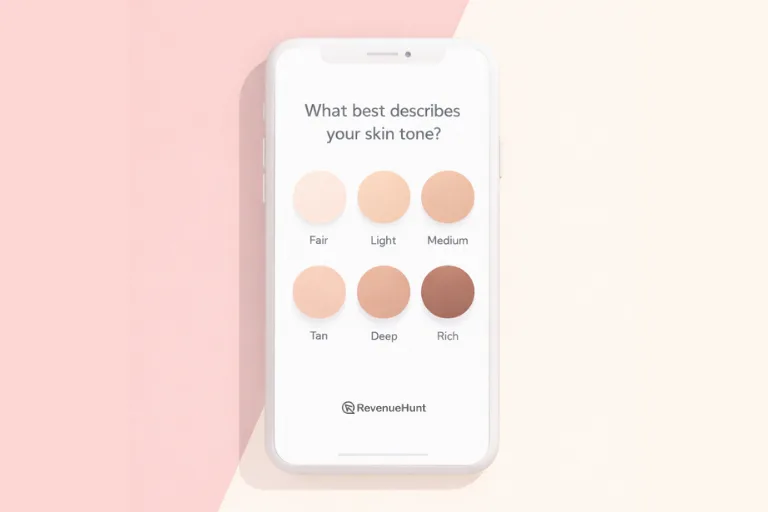
Fig. 05 Picture questions let customers visually identify their skin tone, hair texture, or primary concern, a task text alone cannot reliably accomplish.
Keep answer choices to 3-6 per question regardless of format. More than 6 recreates the paradox of choice problem the quiz is designed to solve.
Map every answer to products
This is the single most common mistake beauty brands make when building their first quiz: leaving answer choices unmapped. Every answer selection should push the recommendation engine toward or away from specific products.
| Quiz answer | What it should do |
|---|---|
| Oily skin | Map to oil-free, mattifying formulations |
| Sensitive skin | Map to fragrance-free, minimal-ingredient products |
| Allergic to retinol | Exclude every retinol SKU from the results page entirely |
A quiz where every answer is mapped produces tight, accurate recommendations that build trust. A quiz with unmapped answers produces generic results that erode it.
Limit results to a focused recommendation
The platform data on results pages is unambiguous:
| Results page setup | Avg. conversion rate | Share of converting quizzes |
|---|---|---|
| Exactly 1 results page | 10.6% | 79% |
| 11+ results pages | 7.1% | Small minority |
For routine quizzes, use recommendation slots - one product per routine step - to deliver a curated set without overwhelming the shopper. For single-product quizzes such as a shade finder, recommend one product with confidence. The entire value proposition of the quiz is eliminating choice, not presenting more of it.
Collect email and connect to your email platform
| Stat | What it means for beauty brands |
|---|---|
| 71% of top-converting quizzes collect email | Email capture is standard practice, not optional |
| 75% of those make it required | Gating captures nearly every finisher's email; it trades some completion for that capture (see the trade-off below) |
| Segmented Klaviyo campaigns earn 3x revenue per recipient | vs generic sends (Klaviyo segmentation benchmark); quiz answers are the data that makes this work |
| 1 in 5 quiz-attributed orders land 30+ days later | The segmentation layer keeps converting for months after the visit |
Email gating is the decision skincare merchants agonise over most, and the platform data frames it as a trade-off. Gating (email required before results) captures nearly every finisher’s address but lowers completion; leaving it optional finishes higher and, on the median, converts slightly better; asking for no email finishes highest but captures nothing:
| Email strategy | Median completion | Median conversion | Median revenue / completion |
|---|---|---|---|
| Required before results (gated) | 76% | 7% | $6.06 |
| Optional | 85% | 9% | $7.77 |
| No email ask | 90% | 5% | $3.99 |
Among skincare quizzes specifically, 43% gate, 32% ask for no email, and 25% make it optional, and fewer than 1 in 10 has Klaviyo connected at all, the clearest sign of how much quiz data still sits unused. The right call depends on your goal: gate it if you are building a retention engine where the captured email compounds into LTV (the reason the top performers gate), or keep it optional if first-session conversion is all you are optimising for.
For beauty brands, the email capture from a quiz is not just a lead. It is a profile. Quiz answers sync as customer tags and Klaviyo properties that power flows generic popup captures can never enable (the full activation playbook is in your Klaviyo list is a graveyard, and the post-quiz flow set is in quiz follow-up emails):
- “Your Personalized Routine” welcome flow segmented by skin type
- “Acne Solutions” drip series for quiz-takers who flagged acne as their primary concern
- “Shade Restock Reminder” for foundation purchasers, filtered by their matched shade family
- Seasonal campaigns segmented by concern category, such as “Winter Dryness Protocol” delivered only to dry-skin subscribers
On Shopify: RevenueHunt syncs natively to Klaviyo via one-click OAuth. Quiz answers flow to Klaviyo customer properties in real time - no Zapier required.
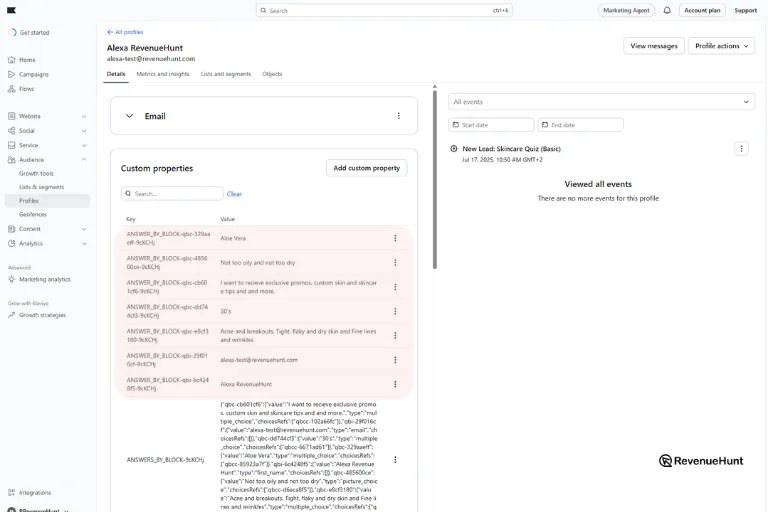
Fig. 06 Quiz answers sync to Klaviyo as custom properties, enabling concern-specific flows that generic popups can never power.
On WooCommerce: Connect your email platform through the RevenueHunt plugin’s integration settings. See WooCommerce email integration documentation for setup steps specific to Klaviyo, Mailchimp, and Omnisend.
Offer a discount strategically
A 10-15% discount at the results page rewards the shopper for sharing preference data and reduces the friction between recommendation and purchase. Discount codes sync automatically from your Shopify or WooCommerce store and apply to the cart without requiring the customer to copy a code manually.
AOV tip: Consider making the discount conditional on purchasing the full recommended routine rather than a single product. A “Save 12% when you buy the complete routine” offer converts the recommendation into a bundle purchase in a single click.
Go global with localisation and compliance
| Platform | Localization support |
|---|---|
| Shopify | Native Shopify Markets integration - automatic language, currency, and catalog availability by region. A German shopper sees the quiz in German with Euro pricing, no manual setup required. |
| WooCommerce | Multi-language support is not natively built in, but functional workarounds are available. See the localization guide here. |
| Both platforms | GDPR and CCPA consent flows are built into every quiz. For EU brands, consent must be granular and explicit - the RevenueHunt consent module handles this out of the box. |
Setup guide: Shopify and WooCommerce
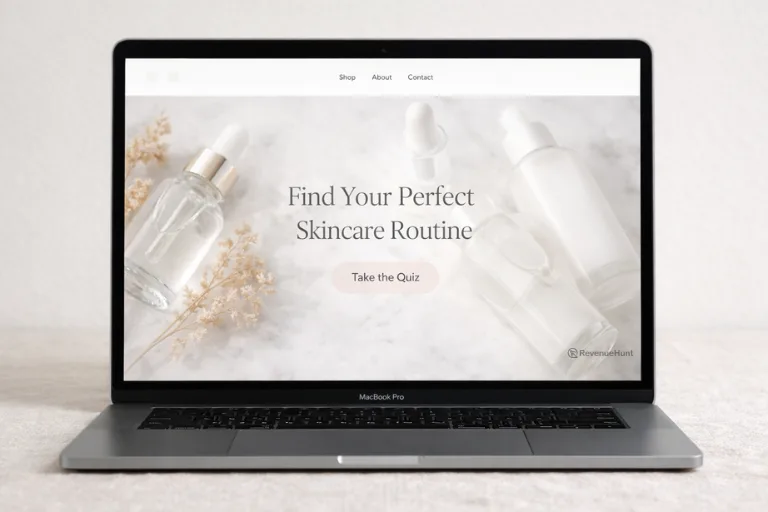
Fig. 07 Embedding the quiz as a homepage hero CTA converts passive browsers into guided, confident shoppers from their first visit.
For Shopify
- Install the 💎Built for Shopify RevenueHunt app from the Shopify App Store. The app is certified Built for Shopify, meaning it meets Shopify’s highest standards for performance, design, and data handling.
- Select a beauty-specific template from the template library: Skin Type Finder, Routine Builder, Shade Matcher, or Gift Guide. Or start from a blank canvas.
- Use the drag-and-drop builder to customize questions, upload images for picture questions, set answer-to-product mappings, and configure conditional logic where needed.
- Connect Klaviyo via one-click OAuth inside the Integrations panel. Confirm the test sync so the first lead flows correctly before going live.
- Publish the quiz as a native Shopify block: homepage hero, collection page inline embed, navigation link, floating button, or popup. The quiz renders natively within your Shopify theme with no iframes and no performance impact.
- For detailed setup steps and video walkthroughs, visit Tutorial Videos.
For WooCommerce
- Install the RevenueHunt plugin from the WordPress plugin directory. Activate it inside your WordPress dashboard.
- Access the same no-code quiz builder, the same beauty templates, and the same recommendation engine used on the Shopify version. The quiz-building experience is identical across both platforms.
- Map answer choices to products from your WooCommerce catalog using the product picker inside the builder.
- Connect your email platform (Klaviyo, Mailchimp, Omnisend, or others) through the Integrations tab. See WooCommerce setup documentation for platform-specific steps.
- Publish via shortcode on any page or post, as a widget in your sidebar or footer, as a full-page embed, or as a popup triggered on exit intent or page scroll.
- For detailed WooCommerce configuration steps, visit the documentation.
Promoting your beauty quiz
Building a high-quality quiz is the first step. Getting it in front of shoppers consistently is what drives the compounding return on that investment. The following placements and promotion strategies reflect what the highest-performing beauty quizzes actually do.
| Placement | Why it works |
|---|---|
| Homepage hero | "Find Your Perfect Routine" as the primary CTA above the fold. The highest-traffic starting point on your site. Shopify: native section block. WooCommerce: shortcode on homepage template. |
| Collection pages | Skin Type Finder on Serums. Shade Matcher on Foundation. Purchase intent is already active - context-specific placement converts higher than a generic homepage quiz. |
| Paid ad landing page | Route Meta traffic to a quiz instead of a collection page. Quiz funnels convert 30%+ better because they eliminate decision fatigue at the exact moment a paid visitor arrives. |
| Main navigation | "Find Your Routine" or "Take the Skin Quiz" in your primary nav. The single highest-visibility placement available without paid traffic. |
| Existing email flows | "Take the Quiz" CTA in your welcome series, browse abandonment, and win-back campaigns. Existing subscribers who complete the quiz retroactively enrich their Klaviyo profiles. |
| Post-purchase flow | "Loving your cleanser? Take the full skin quiz to build your complete routine." Drives cross-sell revenue from customers who already trust the brand. |
| Social media | "POV: I found my perfect skincare routine in 60 seconds." Quiz link in bio. User-generated quiz results create organic social proof for the personalization experience your store offers. |
From quiz to data infrastructure
A quiz that lives only on your product page is a conversion tool. A quiz connected to your email platform, your ad retargeting audiences, and your product development process is something more valuable: the front door to your entire customer relationship.
Every quiz completion generates a customer profile that contains zero-party data your competitors do not have: skin type, primary concerns, age range, ingredient preferences, budget, and gift-vs-self-purchase intent. This data does not decay the way third-party tracking data does. It does not disappear with iOS updates. The customer told you directly. You own it.
| Channel | How quiz data feeds it |
|---|---|
| Klaviyo email and SMS | Flows segmented by skin concern, not just purchase history |
| Meta and Google retargeting | Audiences built from quiz segments - "dry skin, anti-aging" customers targeted with the exact products their profile maps to |
| Product development | If 38% of quiz takers flag a concern your catalog does not address, that is a product roadmap signal |
| Margin protection | Reduced return rates from better first-purchase product matching |
In the post-iOS14 privacy landscape, beauty brands that build zero-party data collection into their customer acquisition flow have a compounding advantage over brands still relying on third-party tracking signals that continue to degrade. The quiz is where the customer relationship starts. Your email platform is where it grows. Your products are where it delivers.
Whether you are running a $500K emerging beauty brand on WooCommerce or a $10M Shopify Plus skincare operation scaling into the EU, the infrastructure is the same: ask the right questions, capture the answers, and let personalization do the selling.
Frequently asked questions
How many questions should a skincare quiz have?
Six to eight is the sweet spot, and routine builders or shade finders can run to nine to twelve. The platform data is clear that longer beats too-short for beauty: quizzes with 1-5 questions convert at 9.8%, 6-8 at 10.4%, and 9-12 at 11.0%. A three-question quiz feels superficial for something as personal as skincare, so aim for a thorough assessment a shopper can still finish on mobile in under two minutes.
Should I build my skincare quiz on Shopify or WooCommerce?
Both run the same no-code builder, the same beauty templates, and the same recommendation engine, so the quiz itself is identical. The difference is the integration layer. On Shopify the quiz installs as a native Built for Shopify block with one-click Klaviyo OAuth and automatic Shopify Markets localisation. On WooCommerce it installs as a plugin published via shortcode, widget, or full-page embed, with email platforms connected through the integration settings.
Which skincare quiz type should I build first?
Start with the skin type finder. It is the minimum viable quiz for any skincare brand and the foundation every downstream personalisation decision rests on. Once it is converting, add a routine builder if average order value is your priority (it recommends a full cleanser-to-SPF set, not one SKU), or a shade matcher if you sell foundation or tinted products.
How does a shade matcher reduce returns?
Wrong shade is one of the top reasons cosmetics get returned. A shade matcher shows skin-tone swatches as picture questions so the customer self-identifies their range, then conditional logic filters the catalogue to matching shades. Getting the first-purchase match right directly removes the most common return trigger, which protects margin.
Do I need Klaviyo to run a skincare quiz?
No to get started. RevenueHunt ships an in-app email sender for the results email, and the quiz works with Mailchimp, Omnisend, HubSpot and others. But Klaviyo is where the segmentation pays off: quiz answers sync natively as customer properties, and segmented Klaviyo campaigns earn about 3x the revenue per recipient of generic sends. See your Klaviyo list is a graveyard for the activation chain.
How do I match products to skin types in the quiz?
Map every answer choice to products in the builder: “oily” pushes toward oil-free, mattifying formulas; “sensitive” toward fragrance-free, minimal-ingredient products; an ingredient allergy excludes those SKUs from the results entirely. Use recommendation slots (one product per step) for routine quizzes, and a single confident pick for shade or single-product quizzes. The full tagging walkthrough is in how to use customer tags in product quizzes.
Start building your beauty quiz today.
Choose a template - Skin Type Finder, Routine Builder, or Shade Matcher - and launch in under 30 minutes.
Available for both Shopify and WooCommerce. No code required.
Free tools & data
Put these benchmarks to work on your own store.
Free tool
Quiz ROI calculator
Estimate the extra revenue and ROI a product recommendation quiz could add to your store. Built on real data, no email required.
Calculate your ROIFree report
Ecommerce quiz benchmark report
How product recommendation quizzes really perform: conversion by category, AOV uplift, and completion, from 45M+ real quiz responses.
Read the report
Most shoppers leave because they can't find the right product