
Quiz follow-up emails: the lifecycle flows that lift revenue
A post-quiz email playbook built on a fictional haircare store: tag quiz answers, sync Klaviyo, and run the lifecycle flows that compound revenue.
A product recommendation quiz captures the customer’s stated preferences (skin type, primary concern, budget, shopping-for) in 60 seconds. The follow-up emails are what turn that data into revenue. Not a single welcome message, but a structured set of lifecycle flows that fire as the customer’s behaviour unfolds: they delivered the result, they didn’t add to cart, they added but didn’t check out, they bought once and went quiet, they’re due to run out of the product they bought. Each scenario is a separate Klaviyo flow with its own trigger and timing, and each one references the same quiz-derived profile properties.
Quick answer
Segmented Klaviyo flows built on quiz data earn 3x the revenue per recipient of generic sends (Klaviyo benchmark). The work isn't a welcome series. It's five lifecycle flows that trigger on different post-quiz behaviours.
One universal results-delivery email at the moment of quiz completion, then five behaviour-triggered flows: cart abandonment (1-72 hours after cart create), browse abandonment (4 hours to 3 days after browse without cart), replenishment (timed to consumable cycle), cross-sell (7-14 days post-purchase), and win-back (60-120 days inactive). Across the platform, 1 in 5 quiz-attributed orders lands more than 30 days after the quiz, which is what these flows capture.
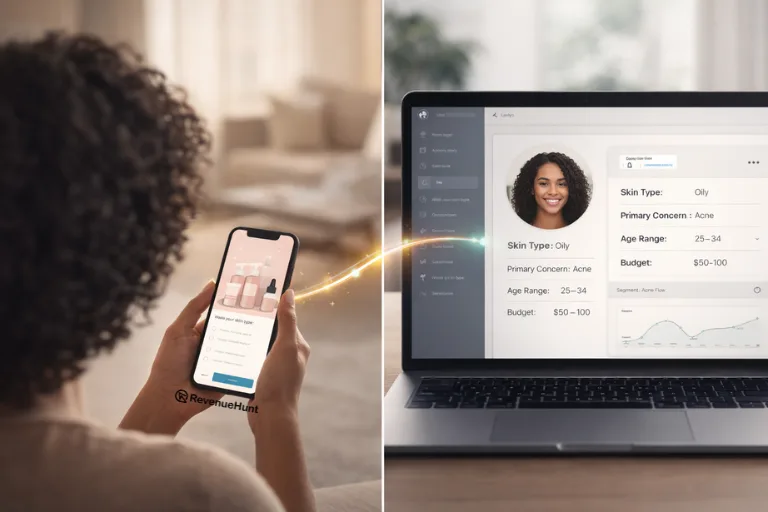
Fig. 01 A Klaviyo profile enriched with quiz-derived zero-party data: skin type, concern, recommended products, customer tags. The same data powers every lifecycle flow described below.
For the underlying data category, see our zero-party data guide. For the full segmentation mapping into Klaviyo, see how Klaviyo segmentation unlocks once zero-party data lands in profiles. To estimate the lift on your store, use our quiz ROI calculator.
Table of contents:
- Set it up once: a haircare store, end to end
- Why post-quiz follow-up emails are revenue infrastructure
- How a quiz answer becomes a Klaviyo segment
- The post-quiz lifecycle flows: one universal + five behaviour-triggered
- Industry-specific timing patterns
- Where your quiz data should flow
- What this stack actually moves
- Frequently asked questions
Set it up once: a haircare store, end to end
The rest of this guide breaks every flow down on its own. But the flows only click once you have seen the whole machine assembled, so here is the complete setup for one concrete store with every technique in place. Meet Lather Lab, a fictional Shopify haircare brand with around 40 SKUs (shampoos, conditioners, masks, scalp serums and stylers) whose shoppers cannot tell which routine is theirs from a product grid. A quiz answers that question in 60 seconds, and the follow-up flows turn each completion into months of revenue.
Step 1, install RevenueHunt and build the quiz
Install the RevenueHunt: Recommender Quiz from the Shopify App Store (free plan available), start from the haircare template, and adapt the questions to the catalogue. Lather Lab’s quiz:
| Quiz question | Answer choices | Customer tag | Drives |
|---|---|---|---|
| Hair type | Straight / Wavy / Curly / Coily | Curly, Coily, Wavy, Straight | Which range to recommend (curl vs smoothing) |
| Scalp | Oily / Balanced / Dry / Flaky | Oily Scalp, Dry Scalp, Flaky Scalp | Scalp serum, clarifying or soothing wash |
| Main concern | Frizz / Dryness / Damage / Thinning / Dandruff | Frizz, Damage, Thinning, Dandruff | The targeted treatment in the routine |
| Wash frequency | Daily / 2-3x week / Weekly | Sets the replenishment cycle | Reorder timing for the replenishment flow |
| Goal | Hydration / Definition / Repair / Growth | Goal: Repair (etc.) | Which step the routine emphasises |
| Colour-treated? | Yes / No | Color-Treated | Bond-repair, colour-safe formulas |
| Your email (required) | Captured just before results | none | The Klaviyo profile everything attaches to |
The reasoning behind question count and order is in how to build a successful product recommendation quiz; in short, 6 to 10 questions, picture-choice for the visual ones (hair type, scalp), and email required just before the results page.
Step 2, publish it as a landing page
Lather Lab does not bury the quiz on a sub-page. It publishes the quiz at its own URL (latherlab.com/pages/hair-quiz) and points its Meta and Google traffic straight at it, the same “quiz as the landing page” move behind the anti-ageing device case study that hit 9.8% conversion on cold traffic. It also drops the quiz in as a native homepage block and a nav-menu link. Every paid click lands on question 1, not a product grid.
Step 3, tag every answer
This is the step that powers everything downstream. In the Quiz Builder, each answer choice is mapped to two things: the products it should recommend, and a customer tag. Lather Lab’s tag set:
- Hair type:
Curly,Coily,Wavy,Straight - Scalp:
Dry Scalp,Oily Scalp,Flaky Scalp - Concern:
Frizz,Damage,Thinning,Dandruff,Volume - Treatment:
Color-Treated
A shopper who answers “curly, dry scalp, frizz, colour-treated” finishes with four tags on her record and a four-step routine on the results page (hydrating curl shampoo, bond-repair conditioner, weekly moisture mask, curl-defining cream). The full tagging walkthrough is in how to use customer tags in product quizzes.
Step 4, connect Klaviyo
In RevenueHunt’s Integrations tab, connect Klaviyo with one-click OAuth (no Zapier, no middleware) and turn on profile sync. That is the whole setup. From then on, every quiz completion automatically forwards the shopper’s contact details, all of their answers, the customer tags from Step 3 and the recommended products to their Klaviyo profile as custom properties. There is no per-question mapping to configure: RevenueHunt creates the properties for you (each answer lands as its own custom property, and the tags arrive on the profile too), ready to use in templates and flow filters.
Step 5, watch responses land in Klaviyo
Now every completion writes to Klaviyo in real time: the email (a required field just before the results page), the six profile properties, the customer tags, and the recommended product IDs. Lather Lab’s old “graveyard” of anonymous subscribers becomes a list where every profile states exactly what that customer wants, which is the whole point of zero-party data in Klaviyo.
Step 6, build the flows on top
With tagged profiles flowing in, Lather Lab builds the post-quiz flows (detailed in the lifecycle flows section below), in the order haircare rewards:
- Results-delivery (universal, immediate): subject line “Your curly, colour-treated routine,” with the four recommended products and a one-click cart link.
- Replenishment on the 6 to 8 week haircare cycle: “Time to restock before you run out,” filtered to the product they bought.
- Cross-sell at 7 to 14 days: completes the routine by adding the matching mask or styler for the same tags.
Cart abandonment, browse abandonment and win-back layer in as traffic grows. Every one of them filters on the same tags from Step 3, so a Color-Treated + Thinning shopper only ever sees messaging for her profile.
Step 7, what Lather Lab should expect
At the haircare medians (7% quiz-to-purchase, $72 AOV), 1,000 monthly completions produce roughly $5,000 per month in immediate results-email revenue. The lifecycle flows compound on top: replenishment on the 6 to 8 week cycle brings a meaningful share of first-time buyers back, cross-sell lifts AOV by completing the routine, and win-back recovers lapsed Color-Treated and Thinning profiles. Across the platform these flows typically push total quiz-attributed revenue to roughly 2x the immediate-only figure within 90 days, and 1 in 5 quiz orders lands more than 30 days out, revenue Lather Lab captures only because the flows exist. Run your own numbers in the quiz ROI calculator.
With the machine assembled, the rest of this guide is the reference manual: what each flow does, when it fires, and the timing that works per industry.
Why post-quiz follow-up emails are revenue infrastructure
A quiz that doesn’t trigger downstream emails is a conversion tool. A quiz that does is retention infrastructure. The difference is structural: the quiz captures 5 to 10 structured preference signals on every completion (skin type, concern, goal, budget tier, shopping-for) that no popup, behavioural pixel or purchase-history pattern can match. Each signal becomes a Klaviyo profile property the moment the quiz finishes. Each property becomes a flow filter. Each flow becomes a personalised revenue moment that targets the customer with the message they’re actually likely to act on.
The numbers behind this aren’t marginal. Across the RevenueHunt platform (20,000+ stores, 45M+ quiz responses, $370M+ in tracked merchant revenue), 71% of top-converting quizzes collect email as part of the quiz flow, and 75% of those make email required. Segmented Klaviyo campaigns earn over 3x the revenue per recipient of generic sends (Klaviyo segmentation benchmark). And 1 in 5 quiz-attributed orders lands more than 30 days after the quiz (2026 benchmark report). That long tail is exactly what the lifecycle flows below capture. Without them, the first session’s conversion rate is all you get from the quiz.
How a quiz answer becomes a Klaviyo segment
The moment a customer finishes your quiz, every answer fires into Klaviyo as a profile property (skin_type: oily, concern: acne). Every customer tag from the quiz logic also lands on the profile. Recommended products attach as a tagged segment. Consent is captured at submission. None of this requires Zapier, middleware or custom integration code on a native Klaviyo connection.
The same customer-tag mechanic is covered in depth in customer tags in a product quiz. The rest of this guide assumes the integration is live and focuses on what to build on top of it.
The post-quiz lifecycle flows: one universal + five behaviour-triggered
Every quiz triggers one universal email (the results delivery, sent immediately on completion). Five additional flows fire as the customer’s behaviour unfolds: they didn’t add to cart, they added but didn’t check out, they bought and need a refill, they bought and could buy more, they went quiet. Each flow references the same quiz-derived profile properties and customer tags; what changes is the trigger condition and timing.
The results-delivery email (universal, immediate)
The transactional confirmation that fires within seconds of quiz completion. Deliver the personalised recommendation with a direct link back to the results page, where products can be added to cart in one click. Subject line uses information-recall tokens to pull the customer’s stated answer into the subject: “Your [skin type] routine: [product name]”. This is the only email every quiz needs regardless of category or stack; everything else below is behaviour-triggered.
Cart abandonment, recommendation-aware
Triggered when a quiz taker adds a recommended product to cart but doesn’t check out. Standard Klaviyo cart-abandonment cadence: 1-4 hours, 24 hours, 72 hours, with each email referencing the original quiz answers rather than the generic “you left items in your cart” template. The quiz angle is the differentiator: instead of “Your cart is waiting”, the email opens with “Based on your [oily, breakout-prone] skin profile, [Product X] is still your best match”. Pair the 72-hour email with a discount tease to recover the segment that bounced on price.
Browse abandonment, tag-conditional
Triggered when a quiz taker views a recommended product but doesn’t add to cart. Lighter touch than cart abandonment: 4 hours, then optionally 3 days. The email references both the browsed product and the customer’s stated quiz answers (“you said you wanted lightweight coverage; here’s a closer look at the matte finish on [product]”). Branch the flow by tag combination so the same customer never receives a competing recommendation from a different quiz answer.
Replenishment, cycle-timed (for consumable categories)
For skincare, supplements, haircare, food, pet food and any product with a predictable consumption cycle. Trigger N days before estimated run-out (cycle length × ~0.8 buys you a re-order window). A 30-day skincare bottle triggers at day 22-24; a 60-day supplement stack triggers at day 48-50. The email references the original quiz tags and the specific product they bought: “Ready to restock your [skin concern] routine before it runs out?” Subscription-anchored replenishment dominates the Supplements top third on the RevenueHunt platform.
Cross-sell / routine completion
Triggered 7-14 days post-purchase on the first quiz-driven order. Recommends complementary products from the same quiz logic: the customer who bought the cleanser for oily skin gets the matching serum and moisturizer for the same profile. The “complete routine” angle outperforms generic bundle pitches because the recommendations come from the customer’s own quiz answers, not a brand assumption. Across the platform, bundle/routine recommendations dominate 59-82% of top quizzes depending on industry, which makes this flow particularly high-leverage.
Win-back, segment-conditional
Triggered 60-120 days after the last open or purchase with no engagement in between. Segment-specific copy: a Curly Hair + Dry Hair profile receives a re-engagement email referencing those specific concerns; a Volume + Anti-Frizz profile gets a different one. Generic win-back emails (“we miss you”) underperform tag-conditional ones substantially. The quiz-derived tag is what makes the win-back feel personal instead of pleading.
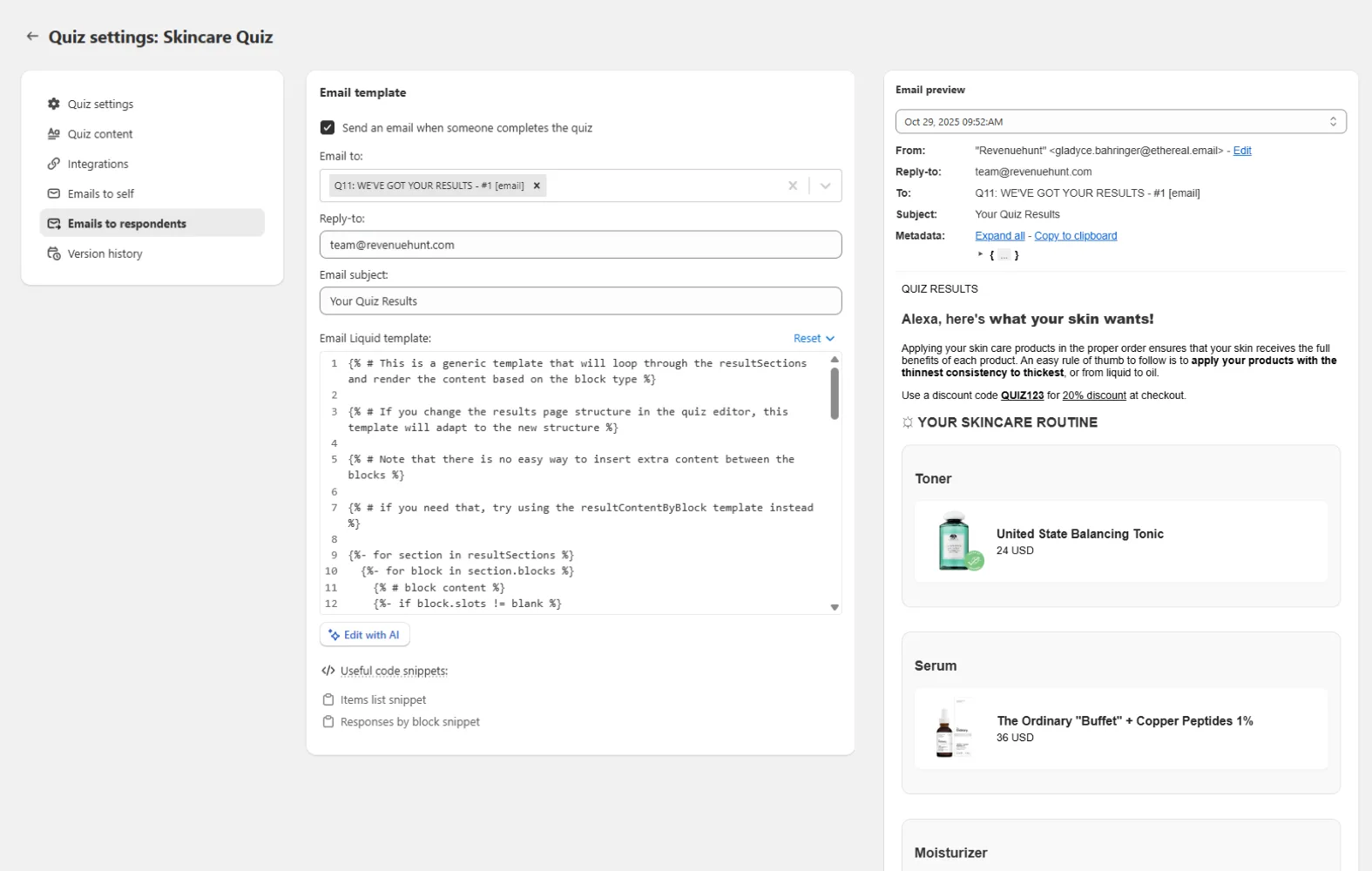
Fig. 05 Sample email draft inside the RevenueHunt app with information-recall tokens pulling the customer's quiz answers into the subject line and body. The same token approach drives every flow above.
Industry-specific timing patterns
The flow architecture is universal. The cadence and which flows matter most shift by category. RevenueHunt platform data across 1,905 Built-for-Shopify quizzes (180 days, 1,092 in the deduplicated stat set) shows:
| Industry | Median conv. | Median AOV | Flows that matter most |
|---|---|---|---|
| Skincare | 8% | $84 | Cross-sell (routine completion) + replenishment |
| Haircare | 7% | $72 | Replenishment (6-8 week cycle) + cross-sell |
| Supplements & wellness | 7% | $85 | Replenishment (30-day cycle) + win-back. Subscription nudge. |
| Cosmetics & makeup | 6% | $65 | Cart abandonment + seasonal cross-sell |
| Fashion & apparel | 4% | $101 | Cart abandonment + browse abandonment. Skip cross-sell. |
| Food & drink | 6% | $67 | Replenishment + subscription nudge |
| Pets | 6% | $72 | Replenishment (food cycle) + cross-sell (accessories) |
The pattern across categories: consumables lean on replenishment + cross-sell. Impulse categories (Fashion, Food/Drink) lean on cart abandonment + browse abandonment. The win-back flow matters everywhere but its timing varies (60 days for impulse, 120 for considered). Start with the two flows your category leans on hardest; layer the rest in once those are running.
Where your quiz data should flow
The lifecycle flows above assume Klaviyo. The architecture also works on Mailchimp, HubSpot, Omnisend, ActiveCampaign and any tool with a webhook endpoint. Only the field-mapping syntax changes between them. RevenueHunt integrations split by how directly they activate quiz data downstream.
Tier 1: native, real-time sync
Klaviyo, Omnisend, and Shopify Customers. Profile properties, segment triggers, and flow activation. The primary engine for most stores. Segmented Klaviyo campaigns earn over 3x the revenue per recipient of generic sends.
Tier 2: CRM and support integration
HubSpot, Mailchimp, ActiveCampaign, and Gorgias. For B2B or DTC brands with longer consideration cycles, and for support workflows where quiz answers pull directly into tickets so the team has context before responding.
Tier 3: flexibility layer
Zapier and webhooks for any tool without a native integration. The webhook payload carries the email, full quiz answer set, and every customer tag the response triggered. RevenueHunt also ships a built-in email sender in the app for stores that haven’t connected an ESP yet. Useful for the results-delivery email on a brand-new store. For the full token reference and SMTP configuration, see the results-email docs.
What this stack actually moves
Personalised post-quiz flows outperform generic sequences because the customer told you what they need; you’re not guessing. The four metrics where this matters:
- Cart-abandonment recovery. A recommendation-aware cart-abandonment flow consistently recovers a higher share of abandoned carts than a generic template. The quiz tags + the cart contents combine into a message no generic recovery flow can match.
- AOV through cross-sell. Bundle/routine recommendations dominate the top third of every category (59-82% share). The cross-sell flow that fires 7-14 days after the first quiz-driven purchase is what realises that pattern across the lifetime, not just the first session.
- Repeat purchase via replenishment. For consumables, the replenishment flow timed to the consumption cycle is the single highest-leverage source of repeat revenue. Subscription nudges layered into the same flow convert one-time buyers into recurring customers.
- LTV via win-back. A
Curly Hair + Dry Hairwin-back at day 90 outperforms a generic re-engagement email substantially. Tag-conditional copy is the reason.
Back to Lather Lab: the compounding math
Take the haircare store from the top of this guide. At 1,000 monthly quiz completions, the 7% haircare-median conversion and $72 median AOV generate roughly $5,000/month in immediate quiz-attributed revenue from the results-delivery email alone. The lifecycle flows add three compounding layers on top: cart abandonment typically recovers 10-20% of would-have-bounced carts; cross-sell at 7-14 days lifts AOV by adding the matching mask or styler across the segment that completes the routine; replenishment on the 6 to 8 week cycle brings a meaningful share of first-time buyers back. Combined, the lifecycle flows typically push total quiz-attributed revenue to ~2x the immediate-only figure within 90 days.

Fig. 07 Per-segment campaign performance dashboard. Tracking open rate, click rate and revenue per recipient per segment is what surfaces the compounding effect; aggregate numbers hide it.
To run the math on your own store’s traffic, AOV and conversion rate, use the quiz ROI calculator. For the full platform-baseline data the calculator pulls from, see the 2026 benchmark report.
Frequently asked questions
Which flow should I build first?
Start with the results-delivery email (it’s the only universal one), then the flow your category leans on hardest per the industry table above. For Skincare, Haircare, Supplements: cross-sell + replenishment. For Fashion, Food, Pets: cart abandonment + browse abandonment. Adding all five at once is usually overkill; build them in order of category fit.
Does the cadence work for every industry?
No. Consumable categories (Skincare, Haircare, Supplements, Food) lean heavily on replenishment + cross-sell because the products run out. Impulse categories (Fashion, Cosmetics, Pets) lean on cart and browse abandonment because the buying decision is fast. The win-back flow matters everywhere; only its timing varies (60 days for impulse, 120 days for considered purchases).
Can I send post-quiz emails if I don’t have Klaviyo or another ESP yet?
Yes, but with constraints. RevenueHunt ships an in-app email sender that can deliver the results-delivery email (the universal one). It can’t run multi-step flows or branch on customer behaviour. The moment you need cart abandonment or any of the four behaviour-triggered flows above, graduate to Klaviyo, Omnisend, Mailchimp, HubSpot or ActiveCampaign. The token reference and SMTP setup are covered in the docs.
How long until the flows produce measurable revenue lift?
The results-delivery email starts converting immediately. The cart-abandonment flow shows lift within 2-4 weeks once you have enough quiz traffic. The compounding flows (replenishment, cross-sell, win-back) need 60-120 days to surface meaningful per-segment differences because the trigger conditions only fire after the customer has progressed through the lifecycle. Across the platform, 1 in 5 quiz-attributed orders lands more than 30 days after the quiz. That’s the long-tail the lifecycle flows capture.
How do I estimate the revenue lift on my store before implementing?
The quiz ROI calculator takes your monthly traffic, AOV, conversion rate and quiz-completion estimate and returns a projected lift range based on the 2026 benchmark report. For a quick sanity check: a haircare store at the 7% category-median conversion and $72 AOV typically sees the lifecycle flows push total quiz-attributed revenue to roughly 2x the immediate-only figure within 90 days.
Build the flows before you think you need them
If your quiz is live but your Klaviyo flows aren’t segmented by quiz result, you’re leaving the most valuable data asset in your account completely idle. The brands that dominate their category are the ones who treat quiz completion not as a conversion event, but as the beginning of a personalised revenue lifecycle.
For 11 real funnels that follow this pattern, see our real funnel examples. For the strategy of how the email lifecycle fits into a complete funnel, see our step-by-step funnel build guide. For where lifecycle email sits among the durable levers in 2026, see our 10-strategy retention pillar.
Explore RevenueHunt’s integrations and start building your first quiz flow today.
Free tools & data
Put these benchmarks to work on your own store.
Free tool
Quiz ROI calculator
Estimate the extra revenue and ROI a product recommendation quiz could add to your store. Built on real data, no email required.
Calculate your ROIFree report
Ecommerce quiz benchmark report
How product recommendation quizzes really perform: conversion by category, AOV uplift, and completion, from 45M+ real quiz responses.
Read the report
Most shoppers leave because they can't find the right product